Friday, May 29, 2009
Long-Term Returns in the Housing Market
This article from the Wall Street Journal seems pretty solid. Let me know if you can see any flaws. The bottom line is that you shouldn't pay any more to own than to rent a house (principal + interest) because the real capital gains about match the other costs including maintenance and property taxes. Of course, that ignores any utility you get from owning rather than renting...


Tuesday, May 26, 2009
George Friedman
If you've been around the investment blogosphere for a while, you've probably come across the writings of George Friedman, CEO of Stratfor, a "private global intelligence firm". Today, I heard George Friedman of Stratfor speak here in Australia. I guess it was part of his global book tour. His book - the next 100 years - was on sale. Usually, I don't read the stuff he writes as it seems very boring to me. I often rely on the spin a friend in Hong Kong puts on his stuff (usually negative). It was much better in person in that regard. He started out pretty well talking about the constraints that political leaders like Obama face and the lack of choice they have with some reference to Machiavelli. He then went on to say what one would have liked to predict about the 20th century and that covered three of the major points - decline of European powers, quadrupling of global population and rise of transport and telecommunications technology. After that, the stuff about Turkey or Poland as "great powers" that I've heard mentioned in regard to his book was OK but speculative when conditioned on "only because the US will invest in Poland like in S. Korea". But whenever he talked about my areas of expertise in economics and energy or to some degree about China he made little sense and sounded very clueless or flat out wrong. For example, he stated that space based solar is inevitable because land based solar would need so much land it would be an "ecological disaster". The latter is clearly not true and no-one I know who knows anything about energy thinks that the gains from 24/7 cloudfree solar could overcome the energy costs of launching a satellite. At least not with any current technology for the size of the solar collector. His other stuff about capitalism requiring a rising price of land which can only occur due to population growth made no sense to me either... and so forth. I didn't have a very high opinion of Stratfor going in - most bloggers like John Mauldin think he is great - and this didn't change my opinion.
Tuesday, April 21, 2009
Take an Economics Test
U.S. High School "Advanced Placement Economics Test courtesy of the New York Times. I got 18/18 but for a couple of questions that was because I knew all the other answers had to be wrong rather than I knew the one I selected was right. It's all macro-economics questions.
Thursday, April 2, 2009
Academia.edu
I just got an e-mail about a new social media things called Academia.edu. The organizers state:
"Academia.edu was founded by Richard Price and a team of people from Stanford and Cambridge University. The aim is for the site to list every academic in the world, together with their university and department affiliation."
But like LinkedIn, I'm not yet sure whether it is really much use for anything else but being seen to be there. From a quick look around, it's overwhelmingly graduate students who are members despite the claim that: "Stephen Hawking, Richard Dawkins, Noam Chomsky, Paul Krugman and Steven Pinker have all added their names to Academia.edu's tree recently, and so have 70% of the Nobel Prize winners for 2008."
"Academia.edu was founded by Richard Price and a team of people from Stanford and Cambridge University. The aim is for the site to list every academic in the world, together with their university and department affiliation."
But like LinkedIn, I'm not yet sure whether it is really much use for anything else but being seen to be there. From a quick look around, it's overwhelmingly graduate students who are members despite the claim that: "Stephen Hawking, Richard Dawkins, Noam Chomsky, Paul Krugman and Steven Pinker have all added their names to Academia.edu's tree recently, and so have 70% of the Nobel Prize winners for 2008."
Tuesday, March 17, 2009
How to Get Cited a Lot
Ultimately for an academic researcher the goal is to get your research cited and used by other people whether in their pure science work or in policy applications. Getting published is nice, but just the first step in an academic career. Also, I believe that as people get more and more familiar with the online citation databases citations will be used more and more to evaluate researchers. So, if you are not yet world famous in your field how do you get people to cite your work among all the other thousands of publications appearing continuously in the academic literature. Here are a couple of methods I have used where I convert what some people (of the Ferriss type) would think were irrelevant distractions into productive activities.
A. Review papers for academic journals so that they can decide whether to publish them. This might seem like a real waste of time. Usually, you aren't paid for it. Maybe you can use it to curry favor with journal editors. Certainly, rejecting review requests from journals you want to publish in is not a good idea unless you have a good excuse - i.e. the paper is not in your area of expertise. On the other hand, I don't accept all requests as I get too many. This isn't a problem for a beginning researcher :) I preferentially accept requests from more prestigious journals and otherwise focus on papers which are:
1. Likely to be published and have not referred to my research when relevant. In my review I state that the authors ought to cite my work.
2. Papers that shouldn't be published but where there is a danger other reviewers for that journal might not see the flaw. Particularly if they cite me but misunderstand or misuse my research.
Occasionally there are papers that should be published that cites my work but misinterprets it. I can put a comment in my review to get a better interpretation in the final paper.
B. I get sent to my Google Reader regular listings of new "working papers" in my field. Working papers are papers that have not yet been published in a journal. But probably they will be published in revised form. This is useful for keeping up with new ideas in the field (some people tell me that this subscription is an irrelevant distraction of course). If a paper does not cite my work but should cite it, I sometimes send the authors an e-mail praising their work and stating that my paper on a related topic may be useful. I attach the paper in question. If I see published papers of this sort I also sometimes send an e-mail as maybe they can cite my paper in their next paper.
Book authors go on tours to promote their work. Why shouldn't academic authors also market their publications? And, yes, this website and blog are also marketing tools.
A. Review papers for academic journals so that they can decide whether to publish them. This might seem like a real waste of time. Usually, you aren't paid for it. Maybe you can use it to curry favor with journal editors. Certainly, rejecting review requests from journals you want to publish in is not a good idea unless you have a good excuse - i.e. the paper is not in your area of expertise. On the other hand, I don't accept all requests as I get too many. This isn't a problem for a beginning researcher :) I preferentially accept requests from more prestigious journals and otherwise focus on papers which are:
1. Likely to be published and have not referred to my research when relevant. In my review I state that the authors ought to cite my work.
2. Papers that shouldn't be published but where there is a danger other reviewers for that journal might not see the flaw. Particularly if they cite me but misunderstand or misuse my research.
Occasionally there are papers that should be published that cites my work but misinterprets it. I can put a comment in my review to get a better interpretation in the final paper.
B. I get sent to my Google Reader regular listings of new "working papers" in my field. Working papers are papers that have not yet been published in a journal. But probably they will be published in revised form. This is useful for keeping up with new ideas in the field (some people tell me that this subscription is an irrelevant distraction of course). If a paper does not cite my work but should cite it, I sometimes send the authors an e-mail praising their work and stating that my paper on a related topic may be useful. I attach the paper in question. If I see published papers of this sort I also sometimes send an e-mail as maybe they can cite my paper in their next paper.
Book authors go on tours to promote their work. Why shouldn't academic authors also market their publications? And, yes, this website and blog are also marketing tools.
Tuesday, March 10, 2009
Book Reviews: Gladwell

I read Blink by Malcolm Gladwell. While it is a good read I found it rather frustrating. I agree totally with the tone of the Wikipedia article. I guess it is too journalistic and not analytical enough. Sometimes making intuitive judgments is good and sometimes it is not. Some people are born with the abilities to make them and other times they can train to have those abilities. Well, the real world is messy I suppose but Gladwell doesn't make it much more tidy.
Next I tried to read "The Tipping Point". After reading about people who are "Connectors", "Mavens", and "Salesmen" I quickly got bored and gave up on reading. Maybe it is just too culturally specific to the US (where I lived ten years so other non-Americans would be really alienated). Very lengthy examples are Paul Revere, Sesame Street etc. It really didn't seem to be about how small things make a big difference as it is subtitled but about how social networks work. It really wasn't about "tipping points" at all as I would understand the term.
Wednesday, March 4, 2009
Book Reviews: Zilliak and McCloskey and Taleb
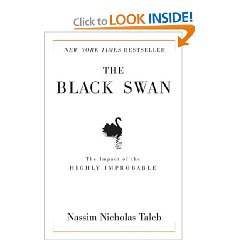

Shuang brought home borrowed copies of Ziliak and McCloskey's "Cult of Statistical Signficance" and Taleb's "The Black Swan". in a way both are rants against standard practice in quantitative analysis. But Taleb's book is ten times better or more than Ziliak and McCloskey's. The latter have a single point that researchers often misuse the concept of statistical significance and ignore the actual size of an effect or variable in favor of just stating that it is "significant" - which just means in statistics that there is a low probability that we think there is an effect when there is none (the probability of falsely rejecting a null hypothesis that is in fact true). Now many researchers write up ineffective discussions of what their research found or make fundamental mistakes in method. But it's not universal and the book never really explains key concepts such as what statistical significance is. It's just one huge rant against all the economists and statisticans that the author feels have oppressed them or their like-thinkers. It assumes we know these things and know the authors critique already (which I do as an economist). The statistician R. A. Fisher is the big villain of the story and Gosset the oppressed hero. But there is never any discussion of exactly what their contributions were.
By contrast, Taleb defines all the basic ideas he uses and has more than one idea. Not all are original of course. Many are commonplace in recent behavioral economics and in more general economics. And they are not esoteric ideas in economics. Winner takes all ideas are in Frank and Bernanke's introductry textbook that I used to teach from. There are notes for the sources at the end of the book. And yes he rants and raves against everyone he believes thinks incorrectly but he does it in an amusing way. I like to read him and didn't find him too annoying. Some people complain about his use of fiction, autobiography, and fictionalised autobiography alongside factual material. In this he reminds me of Robert Pirsig who embedded philosophical and autobiographical material in a story about a motorbike trip across America in "Zen and the Art of Motorcycle Maintenance". I don't have a problem with it. It makes the book much more readable than it would otherwise be.
pys826efuk
Tuesday, February 3, 2009
Why $950?
The Australian government announced its second stimulus package today. Included is a bonus payment of "up to $A950" for every worker earning less than $A100k per year. What an odd number. But the exchange rate with the U.S. Dollar is currently 63 U.S. cents to an Australian Dollar, and if you haven't guessed already, $A950 is exactly $US600, which was the amount of the "stimulus payment" in the first U.S. stimulus package.
Subscribe to:
Posts (Atom)