Tuesday, May 31, 2011

Countdown to Korea


I've booked my trip to Korea for the IPCC Working Group III 5th Assessment Report meeting in Changwon City. I'll also be giving a presentation on 18th July at the Korea Energy Economics Institute. My former student Sung-Kyun Kim started working there earlier this year after getting his PhD from RPI in economics. Work is starting up on the first draft of our chapter, known as the "Zero Order Draft". First task is to read Chapter 3 from the 4th Assessment Report and the guidelines for writing our chapter and connecting our work to the other chapters in the report. We are using some nice tools to coordinate our work which I hadn't used before. One is Dropbox which installs a virtual folder on your computer (on Windows, Mac, or Linux) which is shared across a collaborative team. You can also use it of course, to simply store your own stuff in "the cloud". Another is Doodle which you can use to schedule a meeting. Each of us enter the times we are available to the website. The nice thing is that it automatically gives you the times in your own time zone. This is very useful for a group spanning the time zones from Canberra to California via China, Europe, Africa, and Latin America.

Monday, May 30, 2011

ARC to Abolish Existing Journal Ranking System

The Australian Minister for Innovation, Industry, Science and Research, Kim Carr put out apress release today describing changes to be made in the 2012 ERA research assessment exercise compared to the 2010 ERA. One of the changes is: "The refinement of the journal quality indicator to remove the prescriptive A*, A, B and C ranks". This follows consultation on changes to the ranking scheme. "The Australian Research Council (ARC) will use a refined journal quality indicator for ERA 2012." In other words:

"Evaluation committees will assess the appropriateness of the journals used as publication outlets for research, taking into account any regional or applied focus of the disciplinary unit concerned. For this purpose, evaluation committees will be presented with a profile of the journals (or other relevant publications) used most frequently by the unit under evaluation. The change empowers committee members to use their expert judgement to take account of nuances in publishing behaviour. This approach will allow experts to make judgements about the quality of journals in the context of each discipline.” said ARC CEO, Professor Margaret Sheil.

This is a further step away from quantitative assessment in disciplines such as economics, whereas I think they should move further towards quantitative assessment. On the other hand, this is likely to be a plus for institutions such as the College of Asia and the Pacific at ANU, which have a regional focus.

I think it is to some degree true that:

"There is clear and consistent evidence that the rankings were being deployed inappropriately within some quarters of the sector, in ways that could produce harmful outcomes, and based on a poor understanding of the actual role of the rankings. One common example was the setting of targets for publication in A and A* journals by institutional research managers.

In light of these two factors – that ERA could work perfectly well without the rankings, and that their existence was focussing ill-informed, undesirable behaviour in the management of research – I have made the decision to remove the rankings, based on the ARC’s expert advice."

I don't think that ANU has been overly prescriptive on this, but definitely there has been a feeling that we should try to avoid publishing in journals ranked B or C if possible. I have heard rumors that other universities were telling researchers that it was better not to publish than to publish in a B or C journal. This is diametrically opposed to the previous Australian tendency to publish lots of papers in low ranked journals.

Sunday, May 29, 2011

SNIP and SJR: Two New Journal Ranking Indicators from Elsevier

SNIP - Source Normalized Impact per Paper and SJR - are two new indicators provided by Elsevier based on the Scopus citation database. The indicators are available from the Journal Metrics website.

SNIP takes into account citation practices in the field of interest. A journal's field is the journals citing that journal and the average length of reference lists in papers in that field are taken into account. Also taken into account is the number of those references in the reference lists that are in the database. This defines the "citation potential". This potential is measured relative to the median paper in the dataset which is assigned a potential of 1.0. The ratio of the citations per paper of a journal and its citation potential is its SNIP. This is supposed to allow comparison of citation impact factors across different academic fields. SNIP analyses citations in a given year to articles published in the three previous years (The ISI impact factor uses citations in either the previous 2 or 5 years).

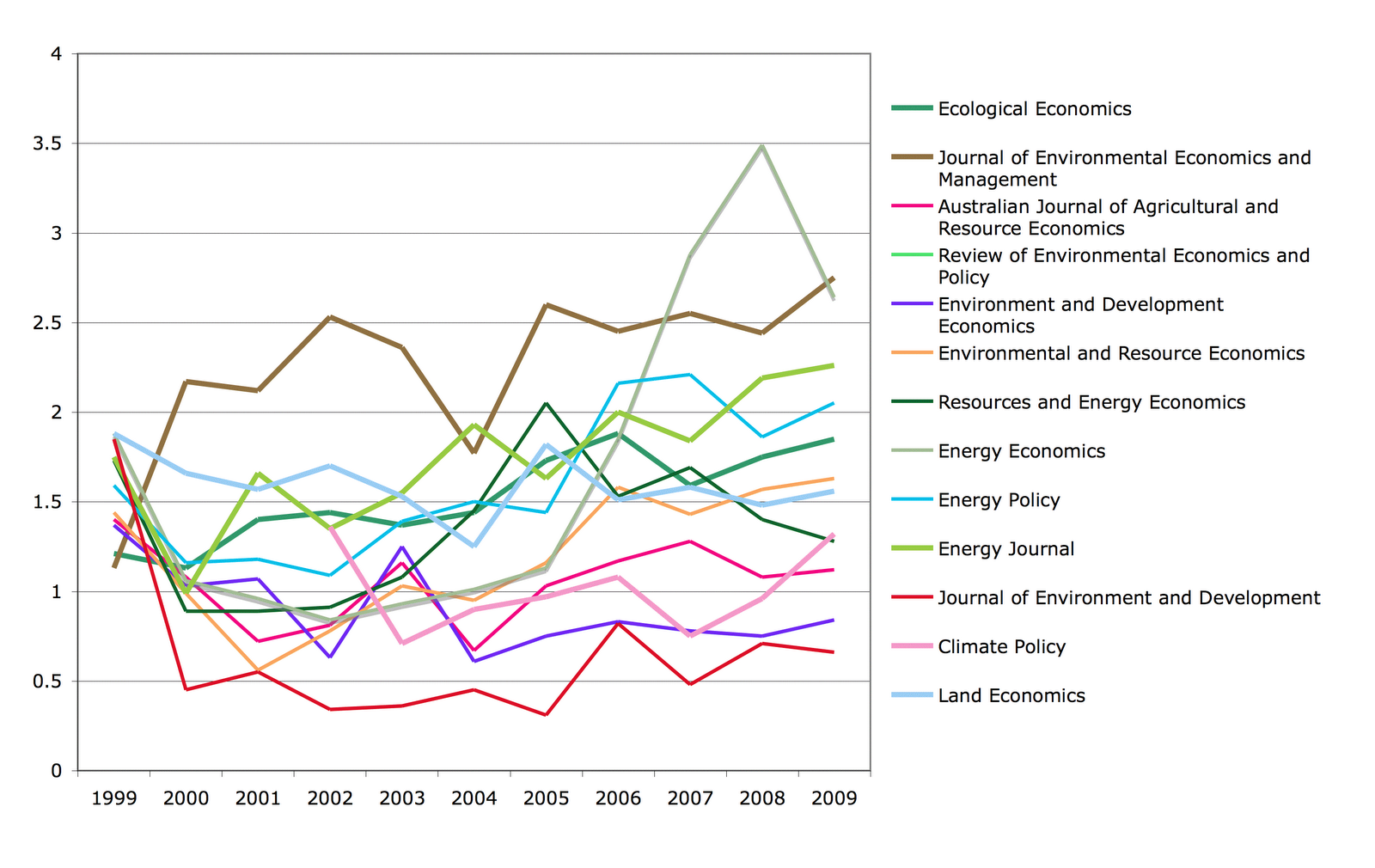
So here are some SNIP scores over the last decade for several environmental and energy economics journals:


I dropped the 2010 SNIP figures as these are all very strange. These are not so different to ISI's impact factors. In particular, we can see the rise in the absolute and relative ranking of the energy journals: Energy Journal, Energy Economics, and Energy Policy. Also JEEM is the top environmental economics journal with Ecological Economics ranked second.

SJR is an eigenfactor type indicator similar in principle to the article influence score produced by eigenfactor.org using the ISI database. I found that these indicators were very volatile on a year to year basis for most of the journals in the sample above and so I'm not sure how useful they are.

Wednesday, May 25, 2011

Enhancements to Scopus

Elsevier have introduced some enhancements to Scopus, their citation index. I'll discuss a couple of these in future posts when I've learnt more about them.

Actually, these might be not new at all, but I only just noticed them. One is the ability to make RSS feeds from Scopus searches and also to embed them on webpages. I've embedded a search for the most recent papers citing my work on my citations page on my website. To do this you'll need to register for both a username and password for ScienceDirect/Scopus and for the feeds. They are two different usernames for some reason. Both are free assuming that you have institutional access to Scopus. Then you need to be logged into to Scopus and do a search. Click on the orange RSS button and then follow instructions to create an embedded code.*

I think it would be great for a department or school to embed a Scopus search of their latest publications on their homepage.

* For ANU users, yes you need to be on campus for this to work.

Sunday, May 22, 2011

Castro e Silva and Teixeira

An interesting paper by Castro e Silva and Teixeira reviews the evolution of themes and types of papers in Ecological Economics over the first 20 years of its existence. The paper joins other bibliometric analyses of the journal including Luzadis et al. (2010), Costanza et al. (2004), and Ma and Stern (2006). Two of their main findings are that:
  • There has been an increase in the number of empirical papers over time together with a decline in formal and "appreciative" papers (these include "theoretical arguments, appreciations, [critique], and judgments").
  • There have been increases in the number of papers on valuation and most other substantive categories together with a decline in "theory-building" papers.
They also compare "seminal papers" with more than 100 citations to others. Theory building and global environmental issues papers are more represented among the highly cited papers.

Castro e Silva and Teixeira argue that these trends indicate that ecological economics is becoming a "post-normal" science. I don't think that the evidence presented says much about the post-normal aspect of ecological economics. I would argue that instead they show that it is becoming a normal science dominated more by empirical problem-solving and less by critiques of existing science and radical new theories.

Invited to Publish a Chapter in an In-Tech Book

Open Access chapters in books with pay to publish fees seems to be a new trend. I got an invite to contribute a chapter to a book published by In-Tech. The publication fee is Euro 590. The book is available for free online but a hardcopy is mailed to each author. What I found to be even weirder is this statement:

"To preserve the integrity of the review process the identity of the editor will be disclosed upon final chapter submission."

In most cases chapters in edited volumes get very few citations except in some cases of respected handbooks and the like (at least in economics). So there is no reason why I would do this, rather than send my paper to some low-end journal. But if this (open access) was done by a reputable press maybe book chapters would get more citations in future?

Visit these blogs for more info on In-Tech.

Thursday, May 19, 2011

Links to Working Paper Versions

I've added links to working paper versions of my publications where those exist to me to publications pages. For the most recent publications that aren't yet in RePEc the main link is to the working paper. My older publications, of course, don't have online working paper versions and neither do most of my natural science publications.

Tuesday, May 17, 2011

ORCID


There is a global system for unique identification of electronic publications: DOI. But so far there is no unique system to identify researchers. Thompson/ISI has Researcher ID but it is dependent on authors registering themselves and is still of limited utility. Databases such as RePEc or SSRN use their own systems. The problem is that though there is only one published academic called D. I. Stern there are lots of people called David Stern or D. Stern. And I'm relatively lucky to have even one unique version of my name. Chinese names are particularly problematic given the high frequency of such names as Liu or Wang. Scopus has an author search system which is quite effective but still makes lots of mistakes in combining and splitting the contributions of different authors. They allow one to contribute corrections but this is again only as useful as Researcher ID in fixing the database. And all these systems are proprietary. Google Scholar has no such system.

So I was interested in hearing of the ORCID initiative to standardize electronic author attribution. One concern is that Google is not a participant. But otherwise this sounds promising.

Saturday, May 14, 2011

The ANU Energy Change Institute Launches Website


The Energy Change Institute at the ANU is launching its website. As you can see from the website, the Institute brings together researchers from many different areas across the ANU from artificial photosynthesis to energy economics and policy and from enhanced oil and gas extraction to solar photovoltaics. Several of my colleagues in the Crawford School and Research School of Economics are involved.

Not only is the Institute aimed at fostering interdisciplinary collaboration across the ANU but it also is planning a strong educational program including professional short courses and a proposed masters by coursework. I am a member of the education committee, representing the energy economics, policy, and governance area. I am also developing a proposal for a course in my areas of research interest.

Sunday, May 8, 2011

Landmark Papers Boost Citations of Authors' Existing Papers

In an article titled "How Citation Boosts Promote Scientific Paradigm Shifts and Nobel Prizes", Amin Mazloumian et al. analyse the citation records of 124 Nobel Prize winners of the last two decades. They find that following the publication of a landmark highly cited paper, the existing papers of these authors receive increased citations. This effect was stronger for the Nobelists than for a randomly chosen sample of published scientists. Of course, this is an example of Robert Merton's Matthew Effect. Here highly cited authors are more likely to be cited as support raising their citation counts further.

Saturday, April 23, 2011

The Role of Energy in the Industrial Revolution and Modern Economic Growth

I wrote this paper with Astrid Kander a few months ago following my visit to Lund, but it has only just been added to RePEc.

In the paper, we develop a simple model of economic growth that allows for a significant role for energy and we apply the model to the Swedish data for the 19th and 20th centuries. To keep things as simple as possible the model is an extension of the famous Solow growth model. Output is measured in terms of gross output without netting out intermediate inputs which allows us to include energy as a regular production input alongside capital and labor. Both technological change and the supply of energy are treated as exogenous in this model but the capital stock evolves endogenously.

We find that the expansion in the supply of energy services over the last couple of centuries has reduced the apparent importance of energy in economic growth despite energy being an essential production input. We find that the elasticity of substitution between a capital-labor aggregate and energy is less than unity, which implies that when energy services are scarce they strongly constrain output growth resulting in a low output steady-state. When energy services are abundant the economy exhibits the behavior of the “modern growth regime” with the Solow model as a limiting case.

This figure, from the paper, attempts to illustrate this point:


It shows the effect of labor-augmenting technological change (the only type in most aggregate growth models) of the size of the optimal capital stock as a function of the amount of effective energy per effective worker. The larger the amount of energy services available per worker the greater the effect of technological change on the capital stock and hence on the output of the economy. Sigma refers to the elasticity of substitution between energy and capital. The smaller it is the sharper the transition from a state where the response of the capital stock is very small to one where it is large. The bottom line is that when energy supply is limited innovation has little impact on growth unless it is innovation directed at increasing the productivity of energy. This is the situation that we argued applied before the industrial revolution.

The expansion of energy services is found to be a major factor in explaining the industrial revolution and economic growth in Sweden, especially before the second half of the 20th century. In the latter period, labor-augmenting technological change becomes the dominant factor driving growth. We can sum this up with a "growth accounting" exercise (not included in the paper):


Capital, labor, and energy are simply the quantities of these inputs. Labor Aug. refers to labor augmenting technological change and energy aug. to energy augmenting technical change. Total factor productivity is a weighted mean of these two components. Energy quality refers to the effects of the shift from lower quality to higher quality fuels over time. Over time capital accumulation and labor augmenting technological change have been more and more important. Increase in energy supply and energy augmenting technological change were most important in the late 19th century, energy quality in the early 20th century. Hence, the claim that energy's importance in growth has declined over time. But it still makes a significant contribution and if energy supply was curtailed in the future could again become more important.

This paper, which we currently are working on a revise and resubmit, is just the first part of what we hope will be an ongoing collaboration on these issues.

Saturday, April 16, 2011

Omumbo et al. Revisit Temperature at Kericho, Kenya

Last year I wrote a series of blogposts about the controversy over malaria and climate change in highland East Africa, and most specifically at Kericho, Kenya. Our previous research had shown that there was no signficant trend in temperature in various locations across Eastern Africa and so the increase in malaria morbidity was unlikely to be due to climate change. Our work was challenged and more recent papers claimed that there were in fact trends. We found that among other things newer versions of the CRU database did show trends in temperature. Now Omumbo et al. have analysed a cleaned up version of the data from the weather station in Kericho.


We were reluctant to use this data previously because of the apparent breaks in the series. The graph shows an apparent increase in temperature of around 3/4 of a degree over 30 years. So I think it is settled now that, at least when more recent data is included, temperature has increased at Kericho. The twist is that in the years since our 2002 publications the incidence of malaria has dramatically reduced.

Friday, April 15, 2011

Astrid Kander


There is an article about my collaborator Astrid Kander in the Sydsvenskan newspaper. Apparently the reporter went to the same high school as her. Google's translation into English sounds quite poetic :)

Thursday, April 7, 2011

Grattan Institute Report on Australia's Carbon Emissions Reduction Policies

The Grattan Institute has put out a report reviewing the performance of Australia's policies to reduce carbon emissions. Maybe you are surprised to find that there are quite a lot of these, actually, including some semi-market based mechanisms. The most important of these is the Renewable Energy Target. Electricity generators have to generate 20% of electricity from renewable sources by 2020. They can achieve this by purchasing certificates from providers of renewable energy. This isn't exactly a market mechanism for reducing carbon emissions themselves as only renewable sources can be used. But it is better than straight regulation.

Last week I saw a presentation on this work by John Daly (Grattan Institute CEO) at the climate policy conference CCEP held at ANU. I think the key graph is this:


This shows the size of the schemes on the left and the cost per tonne of abatement on the right. Costs are measured in terms of direct payments. Hence, efficiency standards appear to be free, which of course is not really the case. Still we clearly see that the grants and rebate schemes haven't generated much abatement and that rebates have been very costly in delivering those reductions. The market based schemes have generated large reductions at reasonable nominal costs.

Sunday, March 27, 2011

Two New CCEP Papers

We have two new CCEP working papers on RePEc:

Inequality, communication and the avoidance of disastrous climate change by Alessandro Tavoni et al.

and


Carbon Pricing that Builds Consensus and Reduces Australia's Emissions: Managing Uncertainties Using a Rising Fixed Price Evolving to Emissions Trading by Frank Jotzo.

We've changed the numbering system from these two papers onwards. Now the numbers have the year as the first two digits. This is because EconPapers appears to ignore the date information in the RePEc file when compiling a list of the papers in a series. The new numbering will ensure that the most recent papers are at the top of the list. Strangely, EconPapers does use the date information to construct a list of papers for an individual. IDEAS behaves consistently in correctly using the date data.

Tuesday, March 22, 2011

ERA Consultation Part II

I previously submitted comments on the ARC's ranked journal list for the 2012 ERA research assessment exercise. You can also submit more general comments on the ERA process. I only submitted one comment, suggesting that economics should be evaluated using citation analysis. Psychology was the only social science evaluated using citations in the 2010 ERA. All natural science, medical, and mathematical fields were evaluated using citation analysis. Citation analysis is widely used in economics, not least by RePEc, and I think the ARC should definitely think again about applying it to economics. One advantage is that it will save a lot of effort on the part of external reviewers who had to provide peer assessment for the 2010 ERA.

Friday, March 18, 2011

New Journal: Economics of Energy and Environmental Policy


Economics of Energy & Environmental Policy (EEEP), is a new journal published by the International Association for Energy Economics, focusing on policy issues involving energy and environmental economics. The first issue will be published in January 2012 and a call for papers has been issued. The editors are Jean-Michel Glachant (European University Institute in Florence, Italy), Paul L. Joskow (Alfred P. Sloan Foundation, USA) and Michael Pollitt (Cambridge University, United Kingdom). The remainder of the editorial board has not yet been announced.

Thursday, March 17, 2011

Japan Nuclear Crisis


Even the Chinese government has suspended it's nuclear power construction program to learn more about what has gone wrong in Japan, but George Monbiot argues that this shouldn't stop us from pursuing nuclear power with certain safeguards. However, the facts are that large earthquakes are possible perhaps anywhere though their probability within any timeframe is lower away from plate boundaries. Many, if not most, coasts are potentially exposed to tsunamis and the chain of events at Fukushima makes me at least wonder how vulnerable nuclear sites, and particularly spent fuel storage areas, are to other threats such as war and terrorism. Not that I haven't wondered about this before of course, but usually have heard reassuring commentary when such concerns have been raised.

P.S.
Our university banned all travel to Japan this morning...

P.P.S.
By far the best coverage I have found of the crisis is on the Guardian newspaper website.

Wednesday, March 16, 2011

Global Trends in Carbon and Sulfur Emissions

I'm preparing a lecture on environmental economics for both my course "Economic Way of Thinking 1" at the Crawford School and as a guest lecture in an introductory economics course at the Treasury. I'm planning to open the lecture by presenting some global and regional trends, focusing on carbon and sulfur emissions. First the global trends using data from CDIAC and Steven Smith:


and then data by country:


Really the global trends for sulfur and carbon are not that dissimilar. Carbon just trends much more strongly than sulfur so that there is slower growth in carbon in the 1980s and 1990s but a decline in sulfur emissions in that period. On the other hand, I don't think that the reversal in the trend of sulfur emissions that I wrote about a few years ago is yet being fundamentally reversed given recent progress in China, though I could be wrong.

The regional CO2 chart shows the UK with flat and declining CO2 emissions as being the outlier. This pattern is typical of several western European countries. The time path of sulfur emissions is much more similar for the UK and US. Reductions in emissions in Europe have been bigger than in North America. Australia is an outlier among developed countries in seeing rising emissions in recent decades.

Wednesday, March 9, 2011

Jones and Romer's Stylized Facts

Actually this very readable article is titled: "The New Kaldor Facts: Ideas, Institutions, Population, and Human Capital". Kaldor proposed six "stylized facts" about the economic growth process. Jones and Romer propose six new ones. They are (in bold with my comments in plain text after them):

1) Increases in the extent of the market. Increased flows of goods, ideas, finance, and people—via globalization, as well as urbanization—have increased the extent of the market for all workers and consumers.

On this, the authors sum up: "When nonrival goods (i.e. ideas/technology) are present, the gains from trade are not exhausted until everyone is connected to everyone else". The traditional model of trade based on comparative advantage says that the gains from economic integration are due to differences in productivity that can be exploited through specialization. According to Jones and Romer, new trade theory is really about increasing market size to exploit ideas on a larger scale.

2) Accelerating growth. For thousands of years, growth in both population and per capita GDP has accelerated, rising from virtually zero to the relatively rapid rates observed in the last century.

This is true but it doesn't rule out the level of technology following a logistic curve with us now somewhere on the steep portion near the middle of the curve. In other words, there could still be limits to technological change and growth.

3) Variation in modern growth rates. The variation in the rate of growth of per capita GDP increases with the distance from the technology frontier.

This isn't what a simple version of the Solow model predicts. It is probably due mostly to differences in the diffusion of advanced technology across the poorer countries. Some are open to improving their productivity and some are not.

4) Large income and total factor productivity (TFP) differences. Differences in measured inputs explain less than half of the enormous cross-country differences in per capita GDP.

This fact is the main one that has to be added to the Solow model of growth in order to make some first order sense of the patterns of development and growth across countries around the world.

5) Increases in human capital per worker. Human capital per worker is rising dramatically throughout the world.

This is subsumed into exogenous technological change in the "neoclassical growth model".

6) Long-run stability of relative wages. The rising quantity of human capital, relative to unskilled labor, has not been matched by a sustained decline in its relative price.

In other words, the wages of skilled workers have not declined relative to those of unskilled workers despite the increasing availability of skilled workers. This can be explained if technological change is "skill-biased", which has increased the demand for skilled workers even as their supply has increased too.

For something somewhat similar regarding energy and economic growth see the conclusions of my survey of the topic.

A Small World or Not?

Academia often seems like a small world where everyone knows everyone else. But my experiences on LinkedIn suggest the opposite. Most of the people I am connected to on LinkedIn are only connected to perhaps 1-2 people that I am already connected to and when I browse their lists of connections there are normally only 1-2 other people that I have ever heard of that I'm not yet linked to. So the areas of overlap in our circles of acquaintance are only a few percent at most. I doubt this is just something unique to me and the people I know. So is it really not a small world at all?

Saturday, March 5, 2011

Director of LSE Resigns over Libya Connections


As an alumnus of LSE I got an e-mail this morning announcing that the Director had stepped down. Here is the full announcement. Here is more background of what must have forced him out.

It's strange that it was fashionable in the last few years to be involved with Libya in Western circles and now again it isn't.