Showing posts with label Annual Review. Show all posts

Saturday, February 7, 2026

Annual Review 2025

Though I only made one post in 2025, this blog is not quite dead yet. Maybe it's just retired like me 😀. I officially retired at the end of November. I've been doing these annual reviews since 2011. They've mainly been an exercise for me to see what I accomplished and what I didn't in the previous year. The focus in 2025 was on the retirement process and my editorship of AJARE.

AJARE; In 2023, I took on the editor-in-chief role together with Yu Sheng and Johannes Sauer. I am the lead editor, and my role includes liaising with AARES as part of the AARES board and proof-reading articles before they are published. It turns out that the latter takes a lot of time to get right. Editing has begun to feel like almost a full time job as the number of articles we have published has gone up. The number of articles we sent to production in 2025 (to be published in 2025 or 2026) was double that in recent years. 2026 is going to be our last year as editors and from some point mid-year the new editorial team of Glyn Wittwer, Tom Kompas, and Deborah Peterson, will start handling new submissions. I was a member of the selection committee. We still have three issues of the journal to produce and five special sections/issues are in process. I will be happy when I won't have to do this any more, though I think it was a worthwhile experience. It's a bit like how I feel about teaching. A little is good, but a lot is hard work.

Conferences and Travel: The AARES Conference was in Brisbane this year, and so I travelled to attend it. We held another "Meet the Editors" session and I presented a paper on "Econometric Modelling of the Impact of Climate Change on Economic Growth." More on that below. In August, I travelled to Sydney to take part in the 2nd Economic Impacts of Climate Change Workshop at UNSW presenting on "How Effective is Carbon Pricing in Reducing Carbon Emissions Intensity? A Meta-Analysis of the Quasi-Experimental Research." I was back in Sydney in September to present at UTS on the same topic.

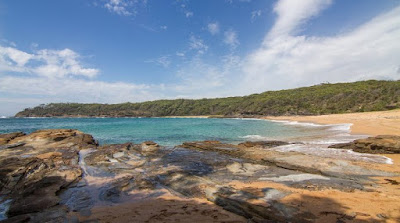
In December, I travelled with my family to Vietnam and China. We travelled on Vietnam Airways. The first leg was a direct flight from Sydney to Hanoi. Hanoi is very busy and noisy and air pollution was very high most of the days we were there. We went on a daytrip to Lan Ha Bay and Cat Ba Island, which was my favourite part of the whole trip. The weather there was perfect.

Cycling on Cat Ba Island 

We then flew to Beijing and visited my mother-in-law in Tianjin. We did a side trip to Hangzhou to meet with one of my wife's friends who splits her time between there and New Jersey now. She is also originally from Tianjin. This was the best part of the China trip.

Leifeng Pagoda and West Lake, Hangzhou 

Finally, we returned to Vietnam, to Danang. This was much more relaxed than Hanoi. We rented a house and my brother flew out from Israel to meet up with us there.


My Son, near Danang

Teaching:  I ended up only teaching one course – IDEC8053 Environmental Economics – in Semester 2. I dropped live lectures, or at least I tried to. I recorded videos of short lecture segments and told the students to watch those before coming to the "workshop". Rarely did anyone actually watch the videos. So, I improvised, giving a mini-lecture on the key points needed to do the "tutorial" problems. Then we did the problems. This kind of worked. Also, I dropped the essay assignment because of AI. Instead, I got students to prepare a presentation. We did the presentations on Zoom. I did 6-8 of these a day until they were all done. It took less time to do these than it would have taken for me to read and grade essays and it was much more fun. Most of the grade was for how well they answered questions.

Research and Publications: It was again a slow year for research. I gave up working on the paper on the economic impact of climate change, which I presented at AARES. Results were very sensitive to small specification changes and I don't understand why. I continued working with my PhD students MiLim Kim and Banna Banik and a group of researchers in Germany including Stephan Bruns and Jan Minx on meta-analysis of the impact of carbon-pricing policies. MiLim submitted her PhD this month and I will be editing her chapter on the topic into a potential journal article soon. Banna's work is at an early stage still.

I published no journal articles or working papers. I did publish some book chapters. One on the rebound effect, one on China's carbon emissions after the pandemic, and there is another one in press on the environmental Kuznets curve.

We resubmitted our paper on recursive impact factors yet again. At the end of the year, we got a revise and resubmit for our paper on electrification impacts in India

Google Scholar citations reached roughly 29,750 with an h-index of 67.

Outreach and Service: As mentioned above, I did almost no blogging. Twitter followers are slightly down! I reviewed 6 journal articles, two tenure/promotion cases, and one grant proposal. I examined two PhD theses. I am taking on far fewer reviews than I used to because of my role as AJARE editor.

Retiring: ANU announced a restructuring program in 2024. In early 2025 a voluntary redundancy program (VSS) was announced. I submitted an application. But then shortly after the deadline, Trump announced his Liberation Day tariffs and financial markets fell. I felt much less certain about living off investments instead of a regular salary. I wasn't sleeping much. I decided to withdraw my application even though my case was approved. In the process, my other course was given away, but I agreed to prepare a new course for 2026 - Economics for Government. Later in the year the university reopened the VSS. All previous applications were reconsidered and I was approved again. This time, I didn't change my mind. Based on the numbers, I thought I could afford to retire. I have been disillusioned with teaching (not that I was ever that excited about it). I thought about going half time and only teaching one course a year. But I would need to work half time for four years to match the money I was paid by the VSS. So, I took the leap. As mentioned above, I am still editor of AJARE for now and have one PhD student I am primary supervisor for. I plan to remain involved with research. Maybe I will even do a bit more. This week, I moved to a smaller office in Old Canberra House and will travel to Adelaide for the AARES Conference next week. Let's see what happens.

Friday, December 27, 2024

Annual Review 2024

I've been doing these annual reviews since 2011. They're mainly an exercise for me to see what I accomplished and what I didn't in the previous year. 

AJARE; Last year, I took on the editor-in-chief role at AJARE together with Yu Sheng and Johannes Sauer. This was the first full year that we were editors. We have produced four regular issues of the journal and launched calls for papers for four special issues. Three of these are public calls for papers. The aim of the calls for papers is to get quality contributions to the journal and signal that we would like more submissions on environmental and resource economics. In February, we held a "Meet the Editors" session at the AARES - AJARE's parent society - conference. We have also completed a new contract between AARES and Wiley that includes shifting the journal to online only publication from next year. I am the lead editor, and my role includes liaising with AARES as part of the AARES board and proof-reading articles before they are published. It turns out that the latter takes quite a lot of time to get right.

Bangkok

Conferences and Travel: The AARES Conference was in Canberra this year and so I didn't need to travel to attend it. I presented my paper co-authored with Suryadeepto Nag on electrification impacts in India. In June, I travelled to Sydney to give a seminar at UNSW and went back in August to present at a climate economics workshop hosted by UNSW in the CBD. In November, I was part of a panel at Crawford's annual China Update Conference talking about changes in Chinese carbon emissions.

At the beginning of the year we went on vacation in Sydney. My brother and his wife were meant to join us, but due to the war in Israel, where they live, they decided to stay home. In July we went on vacation in Maroochydore, Queensland. I've very rarely, if ever, flown somewhere just to go on vacation. Usually, I am going to conferences, traveling to work with people, or visiting friends and relatives. In almost all cases I can think of where we flew somewhere for leisure purposes alone, we added an extra segment to a big multi-purpose trip. So this could be just the second time I have taken a flight just to go on vacation. At the end of the year, I went on a trip to China to visit my wife's relatives and then to Thailand to relax. It was my first trip out of Australia since before the pandemic. I last traveled abroad to the IAEE conference in New Zealand in February 2024. Of course, my second child was born in 2019 and so that also reduced our desire to travel. Now he's five, he is easier to travel with. So, we added a leg to Thailand and back from Guangzhou just to go on vacation. Is this a new non-environmentally friendly trend for me? On the other hand, originally I planned to fly on Thai Airways to Beijing via Bangkok, but the travel agent put us on China Southern, which added two flight segments. 

Townhouses in Thailand

Teaching: This was the third year that I taught IDEC8018 Agricultural and Resource Economics. I taught it together with IDEC8053 Environmental Economics in Semester 2 for the second year running. I again taught lectures in hybrid mode – an in-person lecture live-streamed on Zoom. I disagree with our departmental policy to continue to have online students. Less than 10% of our students are online only. This then requires us to tailor lectures, tutorials, and exams to serve the online audience, which seems to be a case of the tail wagging the dog, in my opinion. If we made an effort to recruit larger numbers of online students, it could make sense. I am thinking of dropping live lectures next year, as there is little interaction with either the in-class or online audience anymore, which is not the case for tutorials. Instead, I would likely have recorded lectures and double the tutorial time.

Research and Publications: It was an even slower year for research. At the beginning of the year I was working on an ARC Discovery Project proposal with researchers at UNSW but we pulled the plug on it and did not submit. I did some work on a paper on the economic impact of climate change, which I presented twice as mentioned above. This paper was an outgrowth of the ARC proposal. I also started working with my PhD students MiLim Kim and Banna Banik and a group of researchers in Germany including Stephan Bruns and Jan Minx on meta-analysis of the impact of carbon-pricing policies. Banna works at the Central Bank of Bangladesh and started the PhD this year.

I published only one journal article with a 2024 publication date:

Timilsina G., D. I. Stern, and D. K. Das (2024) Physical infrastructure and economic growth, Applied Economics,

and I published no new working papers. But I do have two papers under review and one we need to revise and resubmit for the second time.

Google Scholar citations reached roughly 27,750 with an h-index of 64.

Outreach and Service: I again wrote fewer blogposts this year. Three in total compared to five in 2023! Twitter followers rose to 1909 from 1850 the previous year. People keep talking about the demise of academic Twitter. Maybe there are fewer academic economics tweets than before, but it's unclear if there is one single other place where people are congregating. I find Twitter very useful for news and don't want to spend time trawling various platforms looking for content. But the slowdown in new followers suggests that things are changing.

I reviewed 5 journal articles, one tenure/promotion case, and one grant proposal. I am taking on far fewer reviews than I used to because of my role as AJARE editor.

I self-nominated for the IPCC AR7 scoping meeting but wasn't selected. The IPCC held an online meeting for the majority of nominees who weren't selected, which allowed us to provide some input.


Thursday, December 28, 2023

Annual Review 2023

I've been doing these annual reviews since 2011. They're mainly an exercise for me to see what I accomplished and what I didn't in the previous year. 

The big new development this year is that together with Johannes Sauer and Eric Yu Sheng I took on the joint editor-in-chief role of the Australian Journal of Agricultural and Resource Economics. My goal, apart from the usual ones of increasing the impact, prestige, and outreach of the journal, is to get more environmental and resource economics papers published in the journal. So, if you have a suitable paper, please send it to us! We started handling new manuscripts in July and from 1 January we are officially the editors, though we have been increasingly taking on the various roles over the last few months. I will be at the AARES Conference in February, giving a report at the AGM and hosting a "Meet the Editors" session.

I made three trips out of the Canberra and NSW coast region this year, the first since early 2020. I still  haven't been outside of Australasia since 2018. It's pretty hard to travel for any length of time without taking the family and with two small children neither of us feels like traveling anywhere very far. I flew twice to Melbourne for conferences. In March for the Western Economic Association Conference and at the end of November for the Monash Environmental Economics Workshop. I presented our research on electricity markets at both of them.

The third trip was in January to Sydney for a holiday. There is a bit more activity on campus than last year, but it is still much quieter than before the pandemic. For example, we lost three food outlets near Crawford during the pandemic, which haven't returned.

Coogee, NSW

This was the second year that I taught IDEC8018 Agricultural and Resource Economics. Though it was a lot easier than last year, I still had to do quite a lot of preparation for this course. I taught it together with IDEC8053 Environmental Economics in Semester 2. I last taught IDEC8053 in Semester 1, 2021. I taught lectures in hybrid mode – an in-person lecture livestreamed on Zoom. Tutorials were split between an in-person and an online tutorial. The courses went OK, but attendance both online and in-person fell off sharply as the semester progressed. Michael Ward told me that at Monash Economics they are dropping live lectures and switching to pre-recorded material only together with in-person workshops.

It was a slow year for research. I worked on some things that went nowhere, did a couple of projects with visitors, inched a few other things along, and discussed funding proposals. At the end of the year I was working on modelling glacial cycles, which I am trying to give up on, and completing a new paper with Xueting Jiang that hopefully we can post early next year.

I had a couple of visitors to Crawford during the year. Suryadeepto Nag visited Crawford to work with me on his master's project, which I jointly supervised, from late November 2022 to February 2023. We researched the impact of electrification on development in rural India using Indian survey data. The paper has just been rejected by one journal and we are now revising it to give it another shot elsewhere. The editor and referees didn't seem to get the propensity score weighting approach to addressing selection bias.

In July, Khalid Ahmed visited. We wrote a piece on recent developments in Chinese carbon emissions for The Conversation. We managed to publish an updated version in a new journal called Environmental Challenges. Khalid has now moved to Brunei.

I published four journal articles with a 2023 or in press date:

Timilsina G., D. I. Stern, and D. K. Das (in press) Physical infrastructure and economic growth, Applied Economics

Ahmed K. and D. I. Stern (2023) China's carbon emissions trend after the pandemic, Environmental Challenges 13, 100787. 

Jiang X. and D. I. Stern (2023) Asymmetric business cycle changes in U.S. carbon emissions and oil market shocks, Climatic Change 176, 147. 

Kubiszewski, I., L. Concollato, R. Costanza, and D. I. Stern (2023) Changes in authorship, networks, and research topics in ecosystem services, Ecosystem Services 101501. 

The first paper was already in press in 2022 and the last was accepted in 2022 as well. There are also a couple of book chapters.

We posted three new working papers:

Are the Benefits of Electrification Realized Only in the Long Run? Evidence from Rural India. July 2023. With Suryadeepto Nag.

China's Carbon Emissions After the Pandemic. July 2023. With Khalid Ahmed.

More Than Half of Statistically Significant Research Findings in the Environmental Sciences are Actually Not. January 2023. With Teshome Deressa, Jaco Vangronsveld, Jan Minx, Sebastien Lizin, Robert Malina, and Stephan Bruns.

We have one journal article under review at the moment. This is a second submission of our paper on confidence intervals for recursive impact factors. We are also working on a revision of the paper authored by Deressa et al. mentioned above and the revision of the Indian electrification paper. There are several other papers on my to do list, but they range from one we are actively trying to complete, to ones that I haven't really done anything on any time recently and ones that may never happen.

Google Scholar citations reached roughly 26,000 with an h-index of 61. I again wrote fewer blogposts this year. Five in total compared to eight in 2022. Twitter followers rose from 1750 to almost 1850 over the year. People keep talking about the demise of academic Twitter. Maybe there are fewer academic posts than before, but unclear if there is one  single other place where people are congregating. I find Twitter very useful for news and don't want to spend time trawling various platforms looking for content.

I reviewed 8 journal articles, two tenure or promotion cases, one book proposal, and two grant proposals, one promotion case, and one textbook proposal. I am taking on fewer reviews because of my new role as AJARE editor. So, I turn down quite a lot of journal article and some grant review requests. I prioritize journals that I have published in or have been reviewed by recently.

My PhD students Xueting Zhang and Debasish Das both submitted their PhDs in the second half of the year. I took on a new PhD student, Mi Lim Kim, who is working on supply-side climate policy. I also have a new student, Banna Banik from Bangladesh, starting in early 2024.

I am not going to make any more predictions this year, because some of last year's predictions did not materialize!


Sunday, December 18, 2022

Annual Review 2022

I've been doing these annual reviews since 2011. They're mainly an exercise for me to see what I accomplished and what I didn't in the previous year. 
 
This was the second year since I have been back living in Canberra in 2007 that I spent the entire year in the Canberra region (extending to the coast) and the second year since 1991 that I didn't fly on a plane. I also haven't been outside of Australasia since 2018. It's pretty hard to travel for any length of time without taking the family and with two small children neither of us feels like traveling anywhere very far. I think we can finally say that the pandemic is over when ANU finally lifted their mask mandates in late October. The university seems pretty dead post-pandemic outside Kambri at lunchtime. Some of our students are still stuck in China etc. but even people who are in Canberra have been reluctant to show up. Graduation week in mid-December showed a flurry of activity.


Kambri

For the first three months of the year, I was supposedly on long service leave (LSL). This might sound good, but actually it is a sacrifice of close to AUD 50k that I would otherwise have been paid out when I retired. I did it to help the university's budget... In return I only taught one course this year. But I ended up agreeing to teach a course that was new to me: IDEC8018 Agricultural and Resource Economics. This turned out to be a huge amount of work in terms of preparation. I started working on the course in February. So, I'm not sure I gained much from my LSL. The main benefit is that I have now managed to move my teaching to Semester 2, which I think is better.  I taught lectures in hybrid mode – an in-person lecture livestreamed on Zoom. Tutorials were split between an in-person and an online tutorial. I think the course went well given it was the first run and there were various hiccups along the way. The teaching evaluations are strong.
 
The main new research I did this year was our paper on confidence intervals for recursive journal impact factors. This research followed up on my 2013 Journal of Economic Literature which computed standard errors and confidence intervals for journal impact factors. Back then, I speculated that confidence intervals could be computed for recursive impact factors and now we've done it. As usual, various collaborative research projects are in progress. Some are mentioned on my research page. I also worked with Ida Kubiszewski and Bob Costanza on a paper on the field of ecosystem services, which we have already published.

I only published two papers with a 2022 date:

Berner A., S. Bruns, A. Moneta, and D. I. Stern (2022) Do energy efficiency improvements reduce energy use? Empirical evidence on the economy-wide rebound effect in Europe and the United States, Energy Economics 110, 105939.

Jafari M., D. I. Stern, and S. B. Bruns (2022) How large is the economy-wide rebound effect in middle income countries? Evidence from Iran, Ecological Economics 193, 107325.

and one with a 2023 date: 

Kubiszewski, I., L. Concollato, R. Costanza, D. I. Stern (2023) Changes in the authorship, networks, and research topics in ecosystem services, Ecosystem Services 101501.

We have one in press paper:

Timilsina, G., Stern, D. I., and D. Das (in press) Physical infrastructure and economic growth, Applied Economics.

Following ANU signing read and publish agreements with Elsevier and Taylor and Francis among others, these will be my first open access articles in hybrid journals.

We only posted one new working paper:

Confidence Intervals for Recursive Journal Impact Factors. June 2022. With Johannes König and Richard Tol.

We have two journal articles under review at the moment. There are a lot of other papers on my to do list, but they range from one we are actively trying to complete, to ones that I haven't really done anything on any time recently and ones that may never happen.

I gave a couple of online conference and seminar presentations. The first was in March in the FEEM Economic Modelling Seminar Series on the topic of Asymmetric Response of Carbon Emissions to Changes in GDP and Negative Oil Market Shocks. The second was a presentation at Enercon 2022, The 3rd International Conference on Energy and Environmental Economics, hosted by the University of the Philippines Los Banos in July. I was asked to give a presentation on the environmental Kuznets curve.

Google Scholar citations exceeded 23,000 with an h-index of 58. I wrote fewer blogposts this year. Eight in total compared to fifteen in 2021. Twitter followers rose from 1650 to almost 1750 over the year. I reviewed 13 journal articles, two tenure or promotion cases, one book proposal, and one grant proposal. I think about one of these per month is about the right number. So, I turn down quite a lot of journal article and some grant review requests. I prioritize journals that I have published in or have been reviewed by recently.

My PhD students Xueting Zhang and Debasish Das continued their research. Suryadeepto Nag has been visiting Crawford to work with me on his master's project, which I am jointly supervising, since late November. We are researching the impact of electrification on development in rural India using Indian survey data.

Looking forward to 2023, a few things can be predicted:

Thursday, December 30, 2021

Annual Review 2021

I've been doing these annual reviews since 2011. They're mainly an exercise for me to see what I accomplished and what I didn't in the previous year. 

This was the first year since I have been back living in Canberra in 2007 that I spent the entire year in the Canberra region. In fact, it is the first year since 1991 that I didn't fly on a plane. It's not that unusual for me not to leave my country for a year. I didn't travel outside of Australia in 2019. This year, with a two year old and random snap lockdowns happening in the first part of the year, we were not in the mood to travel anywhere overnight even when it was possible. Then from mid-August came the second Canberra lockdown for 2 plus months (the first was during the first wave of the pandemic in March-May 2020). Luckily I was able to take Isaac (the two year old) to daycare throughout the lockdown, but we had to help homeschool Noah (5 years old). I was impressed how well the school organized things. Before Omicron came along, things had returned almost to normality in Canberra. We still needed to wear masks at the daycare and on the bus and needed to check in sometimes at stores etc. The university has been dragging its feet on the return to campus, but the faculty office areas in the Crawford Building have sometimes been even a little bit busy. In the last week of the year, I finally travelled out of Canberra with my family to go on holidays on the NSW South Coast.


While we've been away from Canberra the number of COVID-19 cases has been growing radically. Almost everyone here is vaccinated and Omicron seems less severe, so it's unclear what this will mean for university activity in 2022. They were planning a more or less complete return to on campus teaching, but who knows now...
 
In Semester 1 (from February to June), I again taught environmental economics and the masters research essay course. But this is the last time I will be teaching them. More about that in the 2022 predictions, below. We taught in hybrid mode. In the environmental economics class there was a joint online lecture for online and on campus students and then separate tutorials for the two groups. It turned out that very few people came to the in person tutorial. Often I had only one student. But this session was much better in my opinion than either of the online sessions. The masters research essay class had separate online and in-person classes.
 
I was awarded a Francqui Chair at the University of Hasselt in Belgium for the 2020-21 academic year. The main duty of the position was to give ten hours of lectures. Of course, I didn't actually travel to Belgium and so I gave five online lectures. You can see the videos and read some commentary on my blog.

 
I can't really think of anything notable to say about my research activity this year. It's mostly been a story of completing existing projects. We finally wrapped up our ARC DP12 project (yes, funding started in 2012 and we submitted the proposal in 2011) with the publication of our paper on the Industrial Revolution in JAERE.

I started working on several new ideas in the second half of the year but they don't seem to be going anywhere or have already been abandoned. The exception is our asymmetry paper, which we started thinking about right at the end of 2020 and now is under review.

We published five papers with a 2021 date:

Stern D. I., J. C. V. Pezzey, and Y. Lu (2021) Directed technical change and the British Industrial Revolution, Journal of the Association of Environmental and Resource Economists 8(6), 1079-1114.

Saunders H., J. Roy, I. Azevedo, D. Chakravarty, S. Dasgupta, S. de la rue du Can, A. Druckman, R. Fouquet, M. Grubb, B.-Q. Lin, R. Lowe, R. Madlener, D. McCoy, L. Mundaca, T. Oreszczyn, S. Sorrell, D. I. Stern, K. Tanaka, and T. Wei (2021) Energy efficiency: What has research delivered in the last 40 years? Annual Review of Environment and Resources 46, 135-165.

Dressel B. and D. I. Stern (2021) Research at public policy schools in the Asia-Pacific region ranked, Asia and the Pacific Policy Studies 8(1), 151-166.

Stern D. I. and R. S. J. Tol (2021) Depth and breadth relevance in citation metrics, Economic Inquiry 59(3), 961-977.

Bruns S. B., A. Moneta, and D. I. Stern (2021) Estimating the economy-wide rebound effect using empirically identified structural vector autoregressions, Energy Economics 97, 105158.

and one paper with a 2022 date:

Jafari M., D. I. Stern, and S. B. Bruns (2022) How large is the economy-wide rebound effect in middle income countries? Evidence from Iran, Ecological Economics 193, 107325.

We posted four new working papers:

How Much Does Physical Infrastructure Contribute to Economic Growth? An Empirical Analysis
December 2021. With Govinda Timilsina and Debasish Das.

Asymmetric Response of Carbon Emissions to Recessions and Expansions and Oil Market Shocks
October 2021. With Xueting Jiang.

How Large is the Economy-Wide Rebound Effect in Middle Income Countries? Evidence from Iran
August 2021. With Mahboubeh Jafari and Stephan Bruns.

Do Energy Efficiency Improvements Reduce Energy Use? Empirical Evidence on the Economy-Wide Rebound Effect in Europe and the United States
May 2021. With Anne Berner, Stephan Bruns, and Alessio Moneta.

We have three papers under review at the moment (one – the Europe rebound one – is a resubmission). There are twelve other papers on my to do list, but they range from one we are actively trying to complete, to ones that I haven't really done anything on any time recently.

Google Scholar citations exceeded 21,000 with an h-index of 55. I wrote more blogposts this year. Fifteen in total compared to ten in 2020. Twitter followers rose from 1500 to more than 1650 over the year. I did 3 external assessments of people for promotion or tenure for universities in Australia, Hong Kong, and Germany. Fewer than last year. I only did 11 reviews for journals. I used to do around double this three or more years back. And I reviewed a bunch of papers for EAERE, a proposal for the ARC, as well as giving people feedback on their papers etc.

My PhD student Xueting Zhang completed her first research year. She has made a lot of progress, with three papers at various stages of completion. My other student Debasish Das continued his work on prepaid metering and a lot of other stuff, some of which you can check out on his Google Scholar profile.

Looking forward to 2022, a few things can be predicted: 

  • I will be teaching a new course (for me) in the second semester: Agricultural and Resource Economics. It is going to take a lot of work to prepare this course. 
  • As a result, I won't be teaching in the first semester. Officially, I will be on long service leave, which is how I got my teaching reduced to one course for the year. But I will need to work hard on both the course and research right from the start of the year. OK, I'm feeling like taking 4th January off :) The university has encouraged us to take long service leave to help the budget situation. Taking the leave releases money from the account where it has been set aside and they don't need to pay my salary from the recurrent budget.
  • I'm hoping we will get our paper on the rebound effect in Europe accepted very soon.
  • I probably will stay in Australia for this year too. Anyway, I haven't set up any international travel at this stage.

Saturday, December 19, 2020

Annual Review 2020

I've been doing these annual reviews since 2011. They're mainly an exercise for me to see what I accomplished and what I didn't in the previous year. In the first half of the year we had the bushfires, the hailstorm, and then the pandemic and the "shutdown".

On 5 January we woke up to orange light and visibility of only a couple of hundred metres at best where I live. It felt like being on the surface of Titan (but much warmer :)).


My brother visited from Israel later in the month when conditions were a little better. The day he arrived was the hailstorm. Shortly after that the Orroral Valley Fire got going. At one point we had ash falling in Canberra like snowflakes. In early February I went on my only trip outside Canberra this year to Auckland, New Zealand for the IAEE Asia-Pacific Conference. 
 
 
ANU switched from in person teaching to online teaching in late March. An extra week was added to the semester to give us time to adapt. It wasn't too hard as we already have lot of material online, including lectures recorded in the previous two years. My masters research essay course was very easy to shift online. My environmental economics course was harder. I took the whiteboard in my office home to do tutorials: 
 
 
The big challenge was that the schools closed down for around 8 weeks, I think (my son Noah is 4 years old and in preschool for most of the week usually), at exactly the same time and we also have a baby who was 9 months old then. So, I didn't have much work time that wasn't occupied with teaching. In total, there have been 117 cases of COVID-19 in Canberra (population: 426k) and 3 people have died.

In the second half of the year, school and daycare came back and gradually things got more under control. I was actually quite productive research-wise and finished all the papers that were waiting to be revised and resubmitted when the shutdown struck. Well, after doing a lot of work on a revise and resubmit for Climatic Change, I gave up, resulting in this blogpost instead.

I even started four new projects towards the end of the year. One is about ranking public policy schools in the Asia-Pacific, which we have already submitted.  This is a paper that my colleague, Björn Dressel, long wanted to write. My first paper coauthored with a political scientist. Another is a citation analysis, following up on my 2013 paper in the Journal of Economic Literature. The third is about animal power and energy quality... The fourth is a follow on to our paper in the Journal of Econometrics this year on time series modeling of global climate change. Actually, we might give up on this one too. I was supposed to give a presentation on it at the AGU meeting in December, but we withdrew the paper as our early results were hard to understand.

We also wrote a policy brief for the Energy and Economic Growth Programme on prepaid metering in developing countries.

We published five papers with a 2020 date:

Leslie G. W., D. I. Stern, A. Shanker, and M. T. Hogan (2020) Designing electricity markets for high penetrations of zero or low marginal cost intermittent energy sources, Electricity Journal 33, 106847. Working Paper Version | Blogpost

Stern D. I. (2020) How large is the economy-wide rebound effect? Energy Policy 147, 111870. Working Paper Version | Blogpost

Nobel A., S. Lizin, R. Brouwer, S. B. Bruns, D. I. Stern, and R. Malina (2020) Are biodiversity losses valued differently when they are caused by human activities? A meta-analysis of the non-use valuation literature, Environmental Research Letters 15, 070030.

Csereklyei Z. and D. I. Stern (2020) Flying more efficiently: Joint impacts of fuel prices, capital costs and fleet size on airline fleet fuel economy, Ecological Economics 175, 106714. Working Paper Version | Blogpost | Data and Code

Bruns S. B., Z. Csereklyei, and D. I. Stern (2020) A multicointegration model of global climate change, Journal of Econometrics 214(1), 175-197. Working Paper Version | Blogpost | Data

We posted four working papers. Two of those were already published this year and the links are above. The third is a revised version of our paper on the industrial revolution:

Directed technical change and the British Industrial Revolution. December 2020. With Jack Pezzey and Yingying Lu. Blogpost 1, Blogpost 2

The fourth is a nineteen author review for Annual Review of Environment and Resources:

Energy efficiency: What has it delivered in the last 40 years? December 2020. With Harry Saunders et al. Blogpost

We have five papers under review at the moment (three are resubmissions), one revise and resubmit we are working on, and eight more that we are actively working on or trying to finish.

Google Scholar citations exceeded 19,000 with an h-index of 53. I wrote a few more blogposts this year. This is the 10th this year compared to only three last year. Twitter followers rose from 1250 to 1500 over the year. At one point, I actually unfollowed everyone and then added back people I wanted to follow. This made my Twitter feed more manageable and I lost very few followers in the process. 
 
In July, I moved all my email (more than 160k messages) from Outlook on local hard drives to GMail. I use Thunderbird as the front end. Now all my data is in the cloud (everything else is on Dropbox) and can be accessed from anywhere. I still use locally stored applications, so if I want to use specialized software – for example, my econometrics package RATS – I still need to use my own computer.
 
I did 7 external assessments of people for promotion, tenure, or fellowships for universities in Pakistan, Australia, South Africa, USA, Sudan, and Singapore. I'd only done 9 of these previously in my career according to my records. Hard to explain this sudden rush! As a result, I only did 12 reviews for journals, which was lower than typical in the past. And a bunch of papers for EAERE, a proposal for the ARC...

I taught environmental economics and the masters research essay course again. This was the third time I taught the environmental economics course. After a few weeks we had to shift both courses online as I mentioned above. One of the challenges was carrying out a final exam remotely, which I discussed in a workshop ANU ran in the following semester
 
Xueting Zhang started as my PhD student.  In the first year, she has been focused on coursework, we are now transitioning to research. I have one other student for whom I am the primary supervisor, Debasish Das. He's working on prepaid metering in Bangladesh and other energy related topics. This involves struggling with a big data set. We only used a small sample in the Energy Insight linked above.

Looking forward to 2021, a couple of things can be predicted:
  • I was awarded a Francqui Chair at the University of Hasselt in Belgium for the 2020-21 academic year. So, now I have to come up with ten hours of lectures. What can't be predicted is if I will actually travel to Belgium.
  • I'll be teaching environmental economics and the master's research essay course again in the first semester. This year, we are also introducing a year long "Master's Research Project" in parallel with the one semester "essay".
  • I'm hoping we get the resubmitted papers and the revise and resubmit published, but that is in the hands of the editors, referees, and journal publishers...

Wednesday, December 25, 2019

Annual Review 2019

I've been doing these annual reviews since 2011. They're mainly an exercise for me to see what I accomplished and what I didn't in the previous year. This year continued to feel lke a struggle at times, so it's a good idea to remind myself of what I did manage to accomplish. It felt like I was just trying to finish things this year and not succeeding but we actually started new things too. The big personal news of the year is that our second child Isaac Daniel was born:


As a result I didn't travel much. I gave seminars at Monash and Macquarie Universities and went to the Future of Electricity Markets Summit in Sydney.

We only published two papers with a 2019 date:

Bruns S. B., J. König, and D. I. Stern (2019) Replication and robustness analysis of 'Energy and economic growth in the USA: a multivariate approach', Energy Economics 82, 100-113. Working Paper Version | Blogpost

Bruns S. B. and D. I. Stern (2019) Lag length selection and p-hacking in Granger causality testing: Prevalence and performance of meta-regression models, Empirical Economics 56(3), 797-830. Working Paper Version | Blogpost

and one with a 2020 date:

Bruns S. B., Z. Csereklyei, and D. I. Stern (2020) A multicointegration model of global climate change, Journal of Econometrics 214(1), 175-197. Working Paper Version | Blogpost

We posted three working papers, but only one that is really new:

Estimating the economy-wide rebound effect using empirically identified structural vector autoregressions. August 2019. With Stephan Bruns and Alessio Moneta.

We have three papers under review at the moment (one a resubmission), two revise and resubmits we are working on, and three or four we are trying to finish. So, hopefully the number of publications in the next couple of years will increase. 

Google Scholar citations exceeded 17,000 with an h-index of 52. The trend to fewer blogposts continued – this is only the 3rd blogpost this year. Twitter followers rose from 950 to 1250 over the year.

I taught environmental economics and the masters research essay course again. This was the second time teaching the environmental economics course and things went a lot smoother.

Debasish Das started as my PhD student. He is a lecturer at Khulna University in Bangladesh. We are exploring different research topics like electricity use in Bangladesh and infrastructure and growth.


Looking forward to 2020, a few things can be predicted:
  • In February I am going to the IAEE conference in Auckland, New Zealand. I will be giving a plenary on energy efficiency and the rebound effect.
  • Xueting Zhang will start as a PhD student. Like Debasish, she won an RTP scholarship, which is very competitive for foreign students. 
  • We will be submitting a paper based on the session on zero marginal cost electricity at the Future of Electricity Markets Summit to a special issue of the Electricity Journal. There are some other likely submissions and resubmissions early in the new year, but nothing is 100%.
  • I'll be teaching environmental economics and the masters research essay course again in the first semester.

Sunday, December 23, 2018

Annual Review 2018

I've been doing these annual reviews since 2011. They're mainly an exercise for me to see what I accomplished and what I didn't in the previous year. This year was a bit of a struggle at times, so it's a good idea to remind myself of what I did manage to accomplish.

Me and my mother holding my brother in 1967

Going into this year, I had high expectations for getting more research done, as I finished my term as economics program director at Crawford at the end of 2017. In the first semester, I was teaching a new course, or rather a subject I last taught more than a decade ago – environmental economics – but I thought that should be manageable and had three weeks of class prepared at the beginning of the semester. I definitely don't have a comparative advantage in teaching, it takes me a lot of time and effort to prepare. Then my mother died in the week that class began. This was quite expected – she was not doing well when I visited in December – but of course the exact timing is never known. I didn't travel to Israel for the funeral. I had already agreed with my brother up front to travel for the "stone-setting", which in Israel is 30 days after the death. It is the custom to bury someone on the day they die, if possible, so I didn't want to delay that. After I got back, I got ill with a flu/cold, which resulted in me completely losing my voice so I couldn't teach at all. So this was a difficult semester. In October/November I again got ill with flu/lung infection of some sort and lost a month of research time.

Noah and me in Sweden 

But there were also happier travels during the year. In June and July, I traveled with my wife, Shuang, and son, Noah, to the Netherlands, Finland, Sweden, and Japan. I went to three conferences: the IAEE meeting in Groningen and the IEW and World Congress in Gothenburg. Shuang also attended the World Congress. The visits to Finland and Japan were just for fun. Stephan Bruns was also at the IAEE meeting and actually presented our paper on rebound, which got very positive feedback. Stephan and Alessio Moneta did most of the econometric work on the paper, which we are about to submit now.

In September I went to Rome and Singapore for two workshops. At the Villa Mondragone, near Frascati, outside of Rome, was the Climate Econometrics Conference. I presented a paper that compared different estimators of the climate sensitivity. This produced some unexpected results, and it looks like it needs a lot more work some time! I met lots of people including meeting my coauthor Richard Tol for the first time.

Villa Mondragone near Frascati

In Singapore, I attended the 5th Asian Energy Modelling Workshop, which mostly focuses on integrated assessment modeling. By then, I was confident enough to present the rebound paper myself.

I also went to the Monash Environmental Economics Workshop in Melbourne in November. This is a small meeting with just one stream of papers, but they are all focused on environmental economics, whereas the larger annual AARES conference mostly focuses on agriculture.

Akshay Shanker and I finally put out a working paper that was our contribution to a Handelsbanken Foundation funded project headed by Astrid Kander. We are also branding this as part of our ARC funded DP16 project, as we have also been using ARC funding on it. We also completed work this year on the major part of the work on rebound that was part of the DP16 proposal. Zsuzsanna Csereklyei, who was working on the DP16 project, moved to a lecturer position at RMIT.

The Energy Change Institute at ANU won the annual ANU Grand Challenge Competition with a proposal on Zero-Carbon Energy for the Asia-Pacific. Actually, the project already received several hundred thousand dollars of interim funding from the university in 2018 and I have been working with Akshay on the topic of electricity markets as part of this project. We'll continue research on the topic during 2019.

ECI Grand Challenge Presentation Team: Paul Burke, Kylie Catchpole, and Emma Aisbett

We only managed to publish two papers with a 2018 date:

Burke P. J., D. I. Stern, and S. B. Bruns (2018) The impact of electricity on economic development: A macroeconomic perspective, International Review of Environmental and Resource Economics 12(1) 85-127. Working Paper Version | Blogpost

Csereklyei Z. and D. I. Stern (2018) Technology choices in the U.S. electricity industry before and after market restructuring, Energy Journal 39(5), 157-182. Working Paper Version | Blogpost

But we have several papers in press:

Bruns S. B., J. König, and D. I. Stern (in press) Replication and robustness analysis of 'Energy and economic growth in the USA: a multivariate approach', Energy Economics. Working Paper Version | Blogpost

Bruns S. B., Z. Csereklyei, and D. I. Stern (in press) A multicointegration model of global climate change, Journal of Econometrics. Working Paper Version | Blogpost

Bruns S. B. and D. I. Stern (in press) Lag length selection and p-hacking in Granger causality testing: Prevalence and performance of meta-regression models, Empirical Economics. Working Paper Version | Blogpost

We posted five new working papers, three of which haven't been published yet:

Flying More Efficiently: Joint Impacts of Fuel Prices, Capital Costs and Fleet Size on Airline Fleet Fuel Economy Blogpost
November 2018. With Zsuzsanna Csereklyei.

Energy Intensity, Growth and Technical Change
September 2018. With Akshay Shanker. Blogpost

How to Count Citations If You Must: Comment
January 2018. With Richard Tol. Blogpost

Google Scholar citations approached 16,000 with an h-index of 51.

The trend to fewer blogposts continued – this is only the 9th blogpost this year. Twitter followers rose from 750 to 950 over the year.

Akshay Shanker – his primary adviser was Warwick McKibbin and I was on his supervisory panel – received his PhD with very positive feedback from the examiners. He has a part time position at ANU working on the Grand Challenge Project and I am supervising him on that.

There doesn't seem to have been any major progress on the issues surrounding economics at ANU, that I mentioned in last year's post. Arndt Corden seems to be heading towards being a specialist program dealing with developing Asia and there is no overall identity for economics at Crawford. I increasingly identify with the Centre for Applied Macroeconomic Analysis.

On a related theme, I applied for three jobs on three different continents. One of these – the one in Australia – went as far as an onsite interview, but the more I learnt about the job the less enthusiastic I was, and I wasn't offered it. It was a 50/50 admin/leadership and research position.

Looking forward to 2019, a few things can be predicted:
  • We're about to submit our first paper on the rebound effect and should also put out a working paper or two on the topic.
  • I'll continue research with Akshay on the Grand Challenge project.
  • I'm not planning to go to any conferences this year. I have one seminar presentation lined up at Macquarie University in the second half of the year.
  • My PhD student Panittra Ninpanit will submit her thesis at the beginning of the year, and I have a new student, Debasish Kumar Das, starting. The plan is for him to work on electricity reliability.
  • I'll be teaching environmental economics and the masters research essay course again in the first semester.
 Trying to understand the menu in Finland

Thursday, December 28, 2017

Annual Review 2017

I've been doing these annual reviews since 2011. They're mainly an exercise for me to see what I accomplished and what I didn't in the previous year. As I mentioned in last year's review, I am still struggling with work-life balance. It feels like that there is never enough time to get the work done I need to do and I am always making excuses for not getting things done. So, stopping and looking at what I did get done can help provide some perspective.

I was IDEC (Crawford's economics program) director till the end of the year. Ligang Song will take over as IDEC director in 2018. We continued to work on developing and seeking approval for new programs. We made some progress, but the final outcome will only be known in 2018 (hopefully). There was also quite a lot of work on the review of the Crawford School, the future of Asia-Pacific economics at ANU, economics at Crawford and ANU etc. The Arndt-Corden Department of Economics is officially a separate organizational unit from IDEC. Our plan is that going forward Arndt-Corden will represent the research, outreach, and PhD program components of all the economics activity at Crawford and IDEC will continue as the masters teaching program. This too is a work in progress. 


ANU environment and resource economists, Paul Burke, Frank Jotzo, Quentin Grafton, Jack Pezzey, and me

I made two international trips - one to Singapore and one to Europe and two short trips in Australia to Brisbane and Melbourne.  I went to the Singapore meeting for the IAEE international conference. My wife, Shuang, and son, Noah, came along too and we extended our stay to spend time in Singapore. We took the new direct flight from Canberra to Singapore, which is very convenient. From February there will also be Qatar Airways flights from Canberra, but apparently they will stop in Sydney before continuing to Singapore. That will just save time (maybe) on going between terminals in Sydney. To get to Europe I flew to Adelaide and then took Emirates via Dubai.

I was in Brisbane for the AARES conference. I have always found that the conference is much more dominated by agricultural economics than the journal but almost everything at the conference this time was agriculture related. Most of the environment papers dealt with agricultural impacts. I decided not to go in 2018, though the program is looking more balanced.

In December I traveled to Spain, Germany, and Israel. I gave a seminar at ICTA at the Autonomous University of Barcelona on the role of energy in modern economic growth. This was part of a series of seminars funded by the Maria de Maeztu program.

Speaking at ICTA, UAB, Barcelona

From there, I went on to Germany to work with Stephan Bruns on our ARC project and climate change paper. Alessio Moneta also visited from Pisa for a couple of days. Totally by coincidence, I arrived in Göttingen on the same day as Paul Burke who was touring Germany as part of his Energy Transition Hub activities:

Stephan Bruns, Krisztina Kis-Katos, Paul Burke, and me in Göttingen

We made quite good progress on both projects while I was there, but there is still much to do. We are just over the halfway point with the ARC DP16 project. One short paper is already published in Climatic Change, which discusses the accuracy of projections of future energy intensity. We also have another working paper on the restructuring of the US electricity generation industry and energy efficiency and have a paper under review on aircraft fuel economy.

We also completed and submitted our paper on the macroeconomic aspects of electricity and economic development for the DFID funded EEG project. Publication of the working papers and announcement of the next stages of the project have been much delayed, but there should be news on the latter soon. Together with our PhD student Akshay Shanker, I made a lot of progress on our contribution to a Handelsbanken Foundation funded project headed by Astrid Kander. Well, Akshay did most of the work... The paper  – about why energy intensity declines over time – will now be part of Akshay's PhD thesis.

I published fewer papers than last year, which isn't a surprise, as last year was a record year. There were five articles with a 2017 date:

Stern D. I., R. Gerlagh, and P. J. Burke (2017) Modeling the emissions-income relationship using long-run growth rates, Environment and Development Economics 22(6), 699-724. Working Paper Version | Blogpost

Stern D. I. (2017) How accurate are energy intensity projections? Climatic Change 143, 537-545. Working Paper Version | Blogpost

Zhang W., D. I. Stern, X. Liu, W. Cai, and C. Wang (2017) An analysis of the costs of energy saving and CO2 mitigation in rural households in China, Journal of Cleaner Production 165, 734-745. Working Paper Version | Blogpost
 
Stern D. I. and J. van Dijk (2017) Economic growth and global particulate pollution concentrations, Climatic Change 142, 391-406. Working Paper Version | Blogpost

Stern D. I. (2017) The environmental Kuznets curve after 25 years, Journal of Bioeconomics 19, 7-28. Working Paper Version | Blogpost

and there is one in press at the moment:

Bruns S. B. and D. I. Stern (in press) Overfitting bias and p-hacking in Granger-causality testing: Meta-evidence from the energy-growth literature, Empirical Economics. Working Paper Version | Blogpost

I also published a comment on a paper in Scientometrics:

Stern D. I. (2017) Comment on Bornmann (2017): Confidence intervals for journal impact factors, Scientometrics 113(3), 1811-1813. Blogpost

Follow the links to the blogposts to find out more about each paper.

I also published between 1 and 3 book chapters. It's often hard to work out when exactly a book chapter is published or not! This one is definitely published and it's open access for now. I only do book chapters where I can update an existing survey paper for the purpose. I posted 5 working papers, two of which have already been published and two are in the review process. In total, 6 papers are currently submitted, resubmitted, or in revision for resubmission.

Citations almost reached 14,000 on Google Scholar (h-index: 45) and will be well in excess of that for the end of 2017 when all this year's citations are finally included in Google's database.

I became an editor at PeerJ as part of their expansion into the environmental sciences. So far, I haven't actually handled a paper but I'm sure there will be some relevant submissions soon.

On the teaching side, I convened Masters Research Essay for the first time in the 1st Semester and taught Energy Economics for the last time for now in the second semester. My first PhD student here at Crawford, Alrick Campbell, received his PhD at the July graduation ceremony. He is currently a lecturer at the University of the West Indies in Jamaica.

I have been blogging even less this year than last. This will be the 19th post for 2017, whereas last year there were 35. Lack of time and increased use of Twitter are to blame. My Twitter followers now number more than 750, up from over 500 last year. The most popular blogpost this year was "Confidence Intervals for Journal Impact Factors".


Looking forward to 2018, it is easy to predict a couple of things that will happen that are already organized:

1. As mentioned above, I am ending my term as director of our economics program, IDEC, at the end of this calendar year. I am hoping to be able to focus a bit more on my research and get more balance in the coming year.

2. I will be the convener for Masters Research Essay and teach Environmental Economics in the first semester. I last taught environmental economics 10 years ago at RPI, so it will be quite a lot of work. I was getting a bit tired of teaching Energy Economics and if I did this course, Paul Burke could teach one of our compulsory first year masters microeconomics courses, so I decided to take it on. Both these courses are in the 1st semester and so I won't be teaching in the 2nd semester.

3. Early in the new year we will put out a working paper for our time series analysis of global climate change. We are currently revising the paper to resubmit to the Journal of Econometrics.

Nothing came of the job I applied for last year beyond the Skype interview, but I applied for another one this year...