Wednesday, September 26, 2012

Seminar at Crawford School: Astrid Kander - A Better Way to Assign Responsibility for Carbon Emissions

Astrid Kander will be visiting ANU for a couple of weeks next month and giving a seminar on the 22nd October. We are collaborating on my ARC project on energy transitions. Full details are at this link.

Abstract: 
This presentation will highlight one drawback of the currently very popular consumption based emission estimates for assessing the impact of international trade on carbon dioxide emissions in individual countries. The MRIO (multi regional input-output) method and the SRIO (single regional input-output) method with actual technologies are similar in that they aim at allocating all global CO2 emissions to the country of consumption of the commodities rather than to the producer country. However, both methods have one severe drawback when they are used for assessing responsibility for global emissions; i.e., they neglect the NEGA-emissions, which are the saved emissions in developing countries due to importing goods produced using cleaner technologies in developed countries.

If the amount of CO2 emissions of a country’s consumption, adjusted for international trade, is the key question, then the appropriate method should be the MRIO method (or the SRIO with actual technologies), adjusted for the NEGA-emissions possibly incurred. It is suggested that this revised method could also result in all countries’ emissions summing up to actual global emissions. This new way of measuring responsibility would increase the legitimacy of the calculations as a measure of responsibility for emissions because both the consumption levels and patterns and the production technologies and energy systems of all nations would be taken into account.

Tuesday, September 25, 2012

Post-Doc Position at Crawford School

I am looking for a post-doc to work with me on our ARC funded project Energy Transitions: Past, Present, and Future. As the ad says, we are looking for someone with expertise in computable general equilibrium and macro-economic modelling and an interest in energy and environmental economics and climate policy. If you are interested in the position, it's important to understand that you will be bringing expertise to our team that we don't have. So we really need someone who knows what they are doing rather than someone looking to use a post-doc to learn more about CGE modelling. That said, we do have faculty and students here at Crawford with expertise in CGE modelling and we have a strong concentration in environmental and resource economics and so this could be a good environment to develop your career in the field. I will certainly encourage the successful candidate to publish (including on previous research), attend conferences (some funding available) etc.

It will be an advantage if you have previously worked with the G-Cubed model but we will also consider candidates with experience with other models.

The higher stated salary is the rate of pay for a candidate with a completed PhD.

Please contact me if you have any questions about the position.

Monday, September 17, 2012

MAER-Net Colloqium

Somehow I never mentioned that I will be participating in this year's MAER-Net Colloqium in Perth. MAER-Net is a network of researchers using meta-analysis in economics. Meta-analysis is of course the statistical analysis of existing quantitative studies. It started in the area of medical and drug trials and is now used in many fields. There have been annual MAER Net Colloqia so far in Conway, Arkansas (home of Hendrix College and Tom Stanley), Cambridge, and now Perth. I'm presenting on our meta-analysis of the energy-GDP causality literature. We have a rough draft of a paper completed (as of yesterday) but I'd prefer to get some feedback at the workshop first before putting it up as an official working paper. We do have some interesting findings regarding this literature as well as some suggestions for new meta-analysis models. But if you are interested you will have to be patient :)

Also, a reminder that I will be giving a presentation at UWA on Friday.

Sunday, September 16, 2012

How Bad is the Academic Job Market?

History is supposedly one of the worst most over-supplied fields for academic employment. I often read about how "there are no jobs" and only going to Harvard or Princeton for your PhD can get you a job. But that is anecdote. Here are some data for the US history market. The main issue I think is that only 50% of starting PhD students ever complete the degree. However, of those that do complete the degree 60% end up with tenure track jobs within 10 years of starting. 20% end up in non-academic jobs and 20% are stuck with adjunct type positions that usually pay terribly and are very insecure. This doesn't seem that bad. Of course, the fraction who end up with jobs at research oriented universities is going to be quite small. If you want to have a good chance at a job like that you really do need to go to a top program. The same is true for other academic jobs markets like economics too, of course. Even though the economics job market is better but mainly because a lot of foreign students return to their home country and there are more good non-academic jobs available for econ PhDs.

Monday, September 10, 2012

$10,000 Top Up Awards for APAs

The College of Asia and the Pacific will pay top up awards of $10,000 per year to the most outstanding, newly commencing, PhD students who received APA awards (Australian government fellowships for domestic PhD students). This is a great opportunity to study for a PhD at the Crawford School and receive a much better than average stipend.

Friday, September 7, 2012

Fuel Choices in Rural Maharashtra

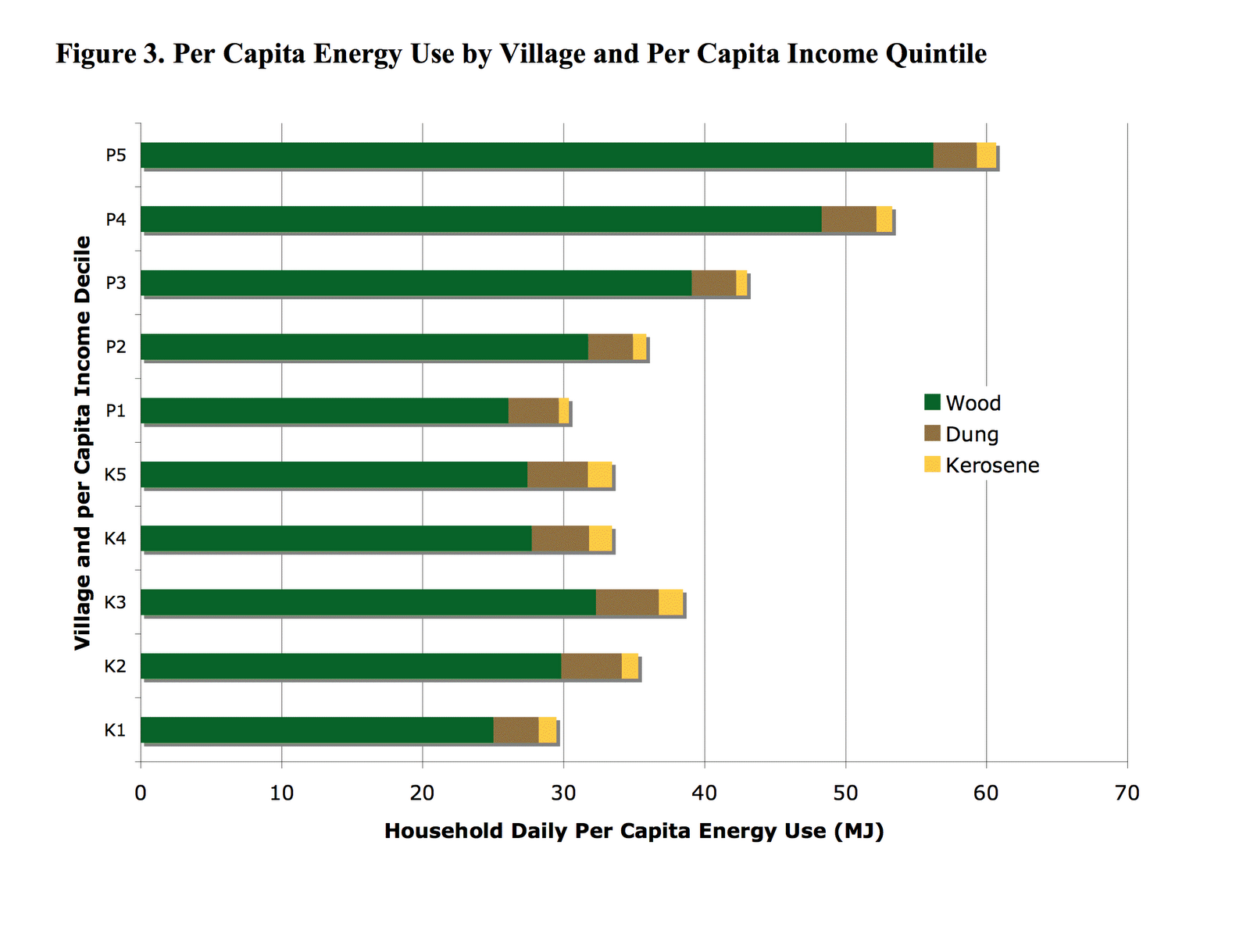
I have a new working paper up coauthored with former masters student Jack Gregory. The paper analyses data from two tribal area villages in Maharashtra State. Jack organized and supervised the survey when he worked for the NGO WOTR in India a few years ago. The surveyed was intended to provide data on greenhouse gas emissions and so had some shortcomings as an information source for understanding energy demand and the choice of fuel. Still, we thought it was worthwhile presenting this information to a wider audience.

We found that there were really big differences between the villages. In the village of Purushwadi income had a big effect on energy use, but there was little relationship in the nearby village of Kohane. Unfortunately, we don't have any explanation for this difference. In Purushwadi the relationship between energy use and income was also different than that found in national surveys.

The national surveys show fairly constant use of biomass across income groups and increased use of modern fuels in the upper half of the income distribution in rural India (Khandker et al., 2012):


The numbers refer to income deciles. Unfortunately, we don't have data on electricity use, though we do have data on electricity connections. Here is the data for per capita energy use that we do have by income quintile in each village (P = Purushwadi, K = Kohane):


It seems to me that research in this area is mostly about coming up with common patterns but understanding more about the differences between villages might be also of interest.

Besides this, our modelling shows modest support for the energy ladder or rather "energy stacking" hypothesis. Energy stacking implies that rural households continue to use traditional fuels but add more and more of the modern ones as their income rises. Also we find that using higher quality energy sources reduces energy use, ceteris paribus. We also find that household size, stove ownership, and season influence rural energy choices. However, the effects of improved stoves are small and not consistent across the villages. This fits with recent evidence for modest or even perverse impacts of improved stoves.

Here are some pictures to give you an idea of what is involved in measuring energy use in rural India:

(a) Measuring rice with a 5 kg basket scale; (b) Measuring a headload of branches with a 25 kg hanging scale; (c) Measuring kerosene with a 200 ml graduated cylinder

Tuesday, September 4, 2012

Visitors to Crawford

We are very happy to welcome Professor Robert Costanza and Dr Ida Kubiszewski as Visiting Fellows to the Crawford School.


Professor Robert Costanza was Distinguished University Professor of Sustainability, in the Institute for Sustainable Solutions at Portland State University. Before moving to PSU in late 2010, he was the Gund Professor of Ecological Economics and founding director of the Gund Institute for Ecological Economics at the University of Vermont. Before Vermont, he was on the faculty at Maryland and LSU, a visiting scientist at the Beijer Institute in Sweden, and at the Illinois Natural History Survey. Bob is also currently a Senior Fellow at the National Council on Science and the Environment, Washington, DC, and a Senior Fellow at the Stockholm Resilience Center, Stockholm, Sweden, and an Affiliate Fellow at the Gund Institute for Ecological Economics at the University of Vermont. Bob is co-founder and past-president of the International Society for Ecological Economics, and was chief editor of the society's journal, Ecological Economics from its inception in 1989 until 2002. He is founding co-editor (with Karin Limburg and Ida Kubiszewski) of Reviews in Ecological Economics. He currently serves on the editorial board of ten other international academic journals. He is also founding editor in chief of Solutions (www.thesolutionsjournal.org ) a unique hybrid academic/popular journal. Bob is the author or co-author of over 500 scientific papers and 23 books. His work has been cited in more than 11,000 scientific articles and he has been named as one of ISI’s Highly Cited Researchers since 2004.


Dr Ida Kubiszewski was a Research Assistant Professor and Fellow at the Institute for Sustainable Solutions, at Portland State University. She is also the Managing Editor of a magazine/journal hybrid called Solutions, launched January 2010. Solutions is an outlet for discussions focusing on solutions to the complex problems we are now facing in the context of whole systems design for a sustainable and desirable future. She is also the co-editor (with Karin Limburg and Robert Costanza) of Reviews in Ecological Economics, published annually by Springer, providing in-depth reviews of the most timely and important issues in the field of Ecological Economics. Ida is also a co-founder and former-Managing Editor of the Encyclopedia of Earth, an electronic reference about the Earth, its natural environments, and their interaction with society. She is a Junior Fellow at the National Council for Science and the Environment and sits on the steering committees or advisory boards of various organizations including the Ecosystem Service Partnership, Environmental Information Coalition, and the U.S. Society for Ecological Economics.

Article on Climate Mitigation Costs in The Conversation


I have an article today in The Conversation explaining the main findings of our recent paper in AJARE. This time I managed to squeeze the "low hanging fruit" in. There is even a picture of bananas :) Go over to The Conversation to read and discuss it.

Crawford School Moves Up to Number 4 (or 2) in Australia


Following the move of CAMA from the College of Business and Economics to the Crawford School, Crawford has jumped from #6 in the RePEc ranking for Australia to #4. Crawford actually is the second highest ranking Australian department in the World ranking in economics after Monash. This is because Australian universities are strong in different indicators than typical institutions globally are.

The Crawford School first entered the top 20% list for Australia in May 2007 at 18th.

Thursday, August 30, 2012

Media Release: Where is it Cheapest to Cut Carbon?

We have a media release out about our Australian Journal of Agricultural and Resource Economics article "Where in the world is it cheapest to cut carbon emissions?"

I actually really like an earlier version of this where we extended the "low hanging fruit" analogy, which really encapsulates our idea:

"Dr Pezzey said that cutting emissions could be compared to picking apples: “We’d expect there to be more ‘low-hanging fruit’ - low cost or easy options for cutting emissions - in countries that have had less aggressive energy efficiency policies and are therefore more emissions-intensive like the US or Australia.” he said.

“But the more fruit there is below a given height, the bigger the total crop is. A common global carbon price is like an agreement on how high up the tree each country should go to harvest emission cuts. So the total cost of such a policy should be higher in an emissions-intensive country, as it requires a larger total cut in its emissions.”

But it's hard to get too many ideas into a very short piece.

Saturday, August 25, 2012

What Happened to the US Sulfur Emissions Market?

An interesting paper from Schmalensee and Stavins on the market for sulfur emissions in the US. This market is often cited as an example of the success of environmental economics and specifically cap and trade and I have used it as that in my teaching in the past. But what has happened more recently? The authors describe it as "ironic". After a period of relative stability often cited as a great success, the price of permits first sky-rocketed and then collapsed:


Essentially, the George W. Bush administration tried to tighten the cap on emissions significantly pushing the price up. In reaction EPA said they'd reconsider starting the collapse in price and then the courts overturned the new regulations. Then a couple of years ago the Obama administration then proposed state based emissions caps and limited interstate trading couple of years ago the market stopped trading entirely.

Schmalensee and Stavins still think that the program was a success if "ironic". I think this shows just how volatile emissions trading programs are and the likelihood of changes being made in response to price spikes that threaten or destroy the program. I think that the volatility of the European Union carbon trading market tells a similar story and increasingly shows that carbon taxes are the way to go. I used to be in favor of emissions trading due to the supposed certainty it would give on emissions reductions but real world experience shows that this could be a case of the perfect being the enemy of the possible.

Thursday, August 23, 2012

Ingelfinger Rule

Until I read this blogpost I didn't know this had a name: "The Ingelfinger Rule". Apparently, Franz Ingelfinger was the editor of the New England Journal of Medicine. In 1969 he ruled that authors couldn't be published in his journal if they engaged in pre-publication or even media publicity around their findings prior to their article seeing print. This was for purely monopolistic reasons. But it is a rule that has become very entrenched across the biomedical and broader biological academic journal world. It hasn't had any influence at all in the world of economics, where prepublication is the norm. Occasionally, economists engaged in interdisciplinary work find that they can't get published because they weren't aware of these very different cultural rules.

Journal Selectivity, Impact Factor, and Citations

Following the debate on Elsevier and open access publication, I have noticed increasing rhetoric about journal impact factors. A journal impact factor is the mean citations received in a given year by articles published in a journal in a number of preceding years. It's long been known that this measure is a rather imperfect indicator of the citation potential of an article published in that journal as the distribution of citations received by articles in any given journal is very dispersed and skewed. A few star articles often get the majority of citations and many more articles are cited little or not at all.

There is a correlation between a journal's impact factor and the number of citations individual articles in the journal get, though it is low. Obviously, it is better to evaluate papers by the number of citations they get themselves. There is an implicit assumption that citations accrue very slowly in the social sciences and especially in economics, so that citations are not useful for evaluating recent research and hence either impact factors or costly secondary peer review are used instead.

We are having an internal debate at the Crawford School about whether to use metrics and which metrics to use in allocation of research funding within the school. So, I have been thinking that if impact factors are only weak predictors of citations are they more strongly correlated with something else? That something else could be the selectivity of journals aka rejection rate. It seems very likely that there is a strong correlation between rejection rate and impact factor.

The problem in testing this is that there seems to be only limited data on rejection rates. I've done a very quick search on this and came up with some information. de Marchi and Rocchi found a significant partial correlation (p=0.04) between rejection rate and impact factor for a sample of 72 journals from all disciplines that responded to their survey. For the ecology journals that Aarssen et al. looked at the correlation between rejection rate and impact factor was 0.687, though there are some low impact journals with quite high rejection rates:


The authors argue that this may be because these low IF journals are flooded with low quality papers that they have to reject. A high rejection rate among a pool of low quality research isn't the same as a high rejection rate among a pool of higher quality research. Still, despite this, IF does seem to be a better predictor of journal selectivity than of citations and on the whole we might think that papers that pass more selective processes tend to be higher quality.


Friday, August 17, 2012

When to Put Out a Working Paper?

In the past I usually put out a working paper version of my research at the same time as submitting the paper to a journal. I assumed that if I thought the paper was ready to be refereed then it was ready to be read by a broader audience too. When I was looking for a job I thought that it was important to get stuff onto my CV as fast as possible. I still usually sent papers, and especially single authored papers, to colleagues for comment before getting to this stage. But some discussions with colleagues, reading blogs, and noting the that some working papers are in fact more or less identical to the published version has made rethink this practice.

Some colleagues reported that they either waited for the first round of comments from a journal before putting up a working paper or that they waited for final acceptance at a journal.

So recently, I have been following a mix of these two strategies, which is one reason why I haven't put up many working papers recently. But I'm still not sure what the best strategy should be.

Thursday, August 16, 2012

ResearchGate 3.0

I've blogged a couple of times about ResearchGate and set up a profile there early in the year. At the time, I wasn't impressed with the coverage of social sciences. Recently, I've noticed a flurry of activity on ResearchGate with a number of colleagues putting up profiles and publications. You can see diffusion in action through the social network. They also have improved coverage in the social sciences including assigning points based on impact factor to journals listed in the Social Science Citation Index. Of course, it would make more sense to use citations rather than impact factors, but the latter is much easier...

So far, I am still finding it less useful than academia.edu or even LinkedIn. I don't really find any of them terribly useful, though occasionally I have been led to an interesting paper...

Wednesday, August 15, 2012

CAMA Moves to Crawford School

As of today, CAMA has moved to the Crawford School from the ANU College of Business and Economics. Warwick McKibbin has already moved into an office just down the corridor from me. I think this is a great development for the Crawford School and will increase our strength in macroeconomics and finance as well as concentrating all ANU environmental and energy economists in Crawford. Bringing CAMA and its network to Crawford should also strengthen our research profile and ranking. Several of us are already research associates in CAMA and I am looking forward to increased collaboration opportunities.

Sunday, August 5, 2012

RePEc Citation Profiles

RePEc's coverage of citations is improving rapidly. It seems Elsevier has agreed to allow RePEc to use citations in Elsevier papers. This has increased the number of my citations in RePEc dramatically as a lot of my citations are in Energy Economics and Ecological Economics. I just found that you can now get a citation profile complete with graphs for anyone registered on RePEc. This joins the profiles available from Google, Scopus, Web of Science, and Microsoft. Of course, it is not as comprehensive as the former three services but probably a lot more accurate than the latter.

Monday, July 30, 2012

ARC Laureate Fellowships Announced

The ARC announced the award of this year's round of Laureate Fellowships. The Laureate Fellowships - previously called 'Federation Fellowships" are the most prestigious grants offered by the ARC they provide a salary top up for the fellow, post-doc positions, and project funds for five years.

ANU won 4 out of the 17 Laureate Fellows announced and the College of Asia and the Pacific got two of these. The other two ANU awards went to my former Fenner School colleague David Lindenmayer and Eelco Rohling who is a climatologist at University of Southampton who will move to the ANU.

Elsewhere, there are several awards for coral reef science and John Quiggin's fellowship was renewed a second time. His proposed research will examine how financial regulation can be improved to reduce the vulnerability of the financial system and the macroeconomy to unforeseen shocks. His previous Federation Fellowship was focused on adaptation to climate change in the Murray Darling Basin.

James Cook university won two fellowships. Apart from that all the awards went to the Go8.

Congratulations to all the recipients!

Wednesday, July 25, 2012

ARC Future Fellowships Announced

The ARC announced the outcomes of this year's Future Fellowships round today. Unfortunately, Crawford didn't get any - we made two applications - but ANU did very well and the College of Asia and the Pacific had a 54% success rate overall. Nationally, the success rate was 35%. Presumably the success rate was high because the ARC unexpectedly brought forward the application date catching a lot of people unawares.

Interestingly, no fellowships were awarded in economics, which may partially explain our zero success rate.

Monday, July 23, 2012

WG3 FoD Now Available for Review


Register here as an expert reviewer of the FoD. This will give you access to the first order draft of Working Group III's part of the 5th IPCC Assessment Report. I'm a coauthor of Chapter 5. In November we will meet in Vigo, Spain to process the comments.

ECI Short Course

I will be presenting in a short-course provided by the Energy Change Institute at ANU: Energy change in a carbon‐trading world. Please pass on the information about the course to anyone you think might be interested.

Thursday, July 19, 2012

Missing Infinity Sign

I just noticed that in the published version of our paper in the current issue of the Energy Journal on p132 6 lines from the bottom of the middle paragraph there is a gap after “AEE ->” where there should be an infinity sign. In other words, as effective energy goes to infinity the stated function of effective energy goes to zero.

I just checked the proofs I was sent back in January and the infinity sign was there correctly in the proofs, so I am going to try to get the journal to fix this in the online version. Most people can probably guess that there should be an infinity sign where the gap is, but it is still annoying that it disappeared between the proofs and the final version of the article appearing.

Especially as this really is one of the key points in our paper. If energy is essential, so that the elasticity of substitution is less than unity between it and capital and labor, then as effective energy gets more and more abundant the growth model gets more and more like the standard Solow growth model where energy doesn't affect growth.

P.S. 30th July 2012

I just heard from the journal that they have corrected this in the electronic version of the article. I'm impressed by how quickly this was resolved.