Wednesday, November 28, 2012

Information for Prospective PhD Students

In the US, a proposal is not a requirement for applying to do a PhD. Usually, students do one to two years of coursework before writing their proposal and it is enough to confirm that a department has faculty specializing in the general area that a student is interested in, say energy economics or climate change in my case. But, here in Australia, we expect students to submit a detailed proposal, even though in practice this proposal will be extensively revised after they start study. And in our economics program there is a year of coursework before students switch to research only. It makes sense to me for a student to select an area of interest to the potential supervisor and then discuss with the supervisor how to develop the proposal. Of course, a student might have a burning issue that they can't wait to conduct research on. But I doubt there are really many such cases. I certainly didn't know what I wanted to research. This was one of the main reasons I went to study in the US rather than remain in the UK. In the UK I would have needed to submit a proposal with my application.

Jack Pezzey has some good guidelines to help potential PhD students think about the application process in Australia. He recommends developing the proposal in consultation with him. He also has a great summary of his current research interests. That was meant to be one of the purposes of this blog. I used to have a research page on my website. But I scrapped that when I started this blog. I've decided it's time to put up a research page again. I hope this will be useful to give potential PhD students and collaborators an idea of what I am currently working on or would be interested in working.

Some previous thoughts on PhD applications.

World Energy Outlook 2012 and the Rebound Effect

I have been reading the 2012 World Energy Outlook from the IEA.  There is a special focus section of three chapters on the role that energy efficiency improvements could play in reducing greenhouse gas emissions. The report is generally very conservative on estimated uptake of alternative energy and, therefore, efficiency will be needed if there is to be any chance of staying within a 2C trajectory.

There is, however, only one mention of the rebound effect in this whole section in Box 10.2 on p316. Somehow they come up with an estimated rebound effect of only 9%. This is almost certainly an underestimate of the rebound effect. Typical estimates for direct rebound in consumer applications are around 30%, while on the production side and at the macro-level rebound effects can be much larger than this. The report does correctly note that:

"A significant portion of this could avoided by appropriate pricing policy"

A cap on carbon emissions will induce energy efficiency improvements as part of the solution. Though there will still be a rebound effect it can't result in the emissions reduction goal not being met. However, an efficiency policy without a carbon cap is likely to yield disappointing results in my opinion. With a carbon tax, rebound means that the carbon tax would have to be higher than it would be if there was no rebound, I think.

Wednesday, November 21, 2012

Being on the Cutting Edge

I was just reading another essay by Paul Graham, which I thought was worth linking. A lot of this is true for academic research too. The best way to get lots of good research ideas is to put yourself at the cutting edge. Doing research on any idea you have should lead to more ideas. Having a prepared mind is important. Studying and doing research prepares your mind. A short-cut is to put yourself in an environment where there are people at the cutting edge. This is why it is important to go to a good place to do graduate study etc. Going to conferences and seminars even not in what you think is your area. Something a lot of grad students don't do, but the successful ones do.

Eventually, you'll find you have so many ideas you have to pick and choose and prioritize between them. Having ideas will no longer be the problem, bringing them to fruition will be. That's when you'll start getting other people to work on them for you :)

Update

I haven't posted so far this month. I have been travelling. First I was at the IPCC Working Group 3 meeting in Vigo, Spain. Then I was in Vienna where I gave a presentation on trends, drivers, and mitigation of climate change at W.U.. Now I am in Israel visiting family. Just coincided with kind of a war going on... Early tomorrow morning I start the long trip back to Australia.

Wednesday, October 31, 2012

PLoS ONE: SNIP2 vs. SJR2

I know a lot of my readers arrive via searches for information on PLoS ONE. So as a follow up on my post on SNIP and SJR here is the data for PLoS ONE:


Two things stand out: First, the journal gets cited in strong citing journals as its SJR is relatively higher than its SNIP. Second, like the Article Influence and Impact Factor, SJR falls in 2011 vs. 2010 though SNIP is flat.

SNIP2 vs. SJR2

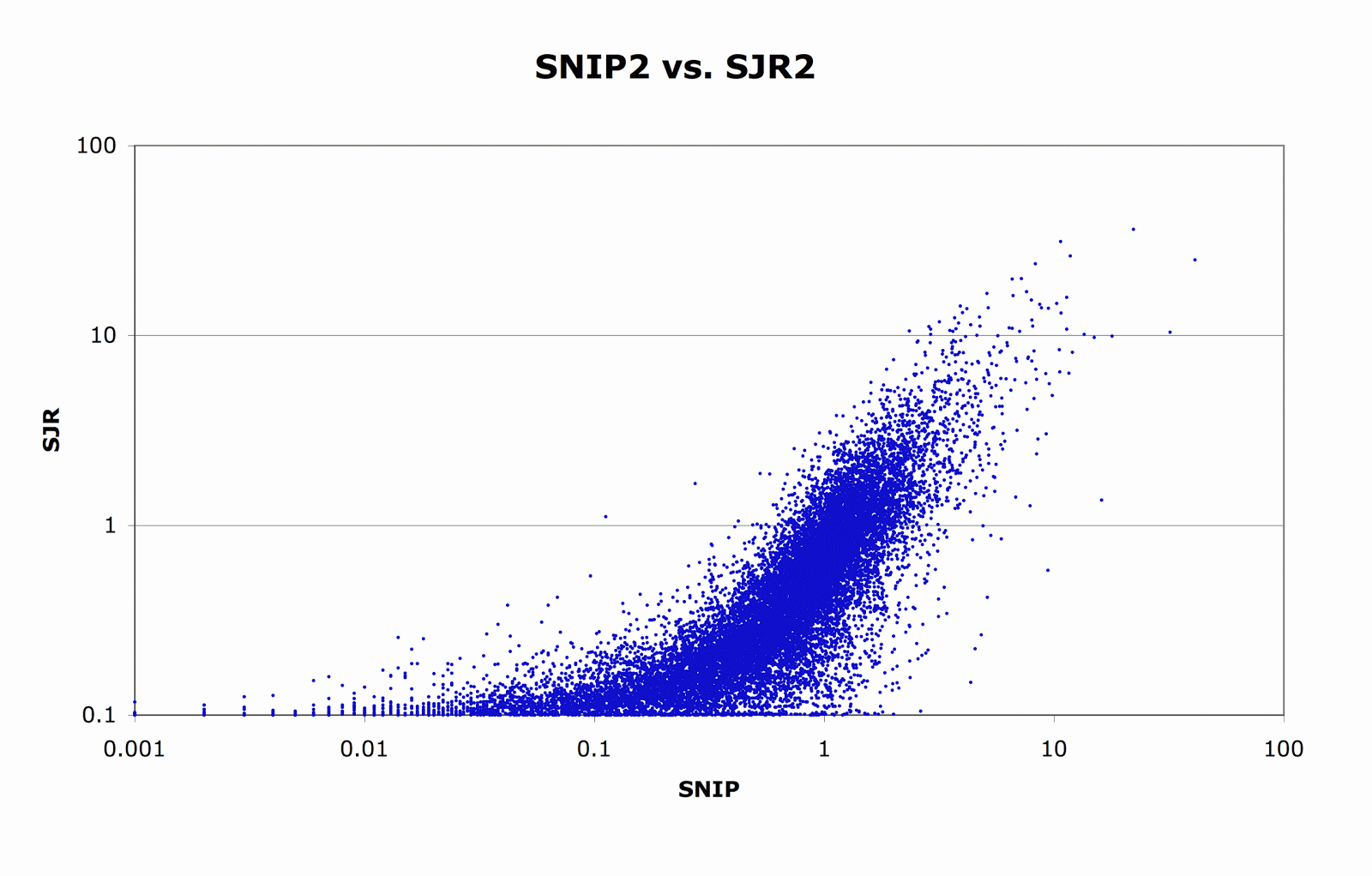
Following up from Monday's post on SNIP2 and SJR2. I finally got a copy of the full database. 16866 journals have both a non-zero SNIP and a non-zero SJR for 2011. It's hard to understand how a journal could have a positive SJR but a zero SNIP, but there are a lot of such journals. There are a total of 32060 journals in the database. I plotted the two indicators for the subsample of journals against each other:

 
The relationship is pretty linear in log-log space except that SJR is truncated at 0.1. The correlation between the two series is 0.75 (0.77 for the log series). 

There are 646 economics, econometrics, and finance journals that have a non-zero SNIP and SJR. Here is the scatterplot for the two indicators for this sample:


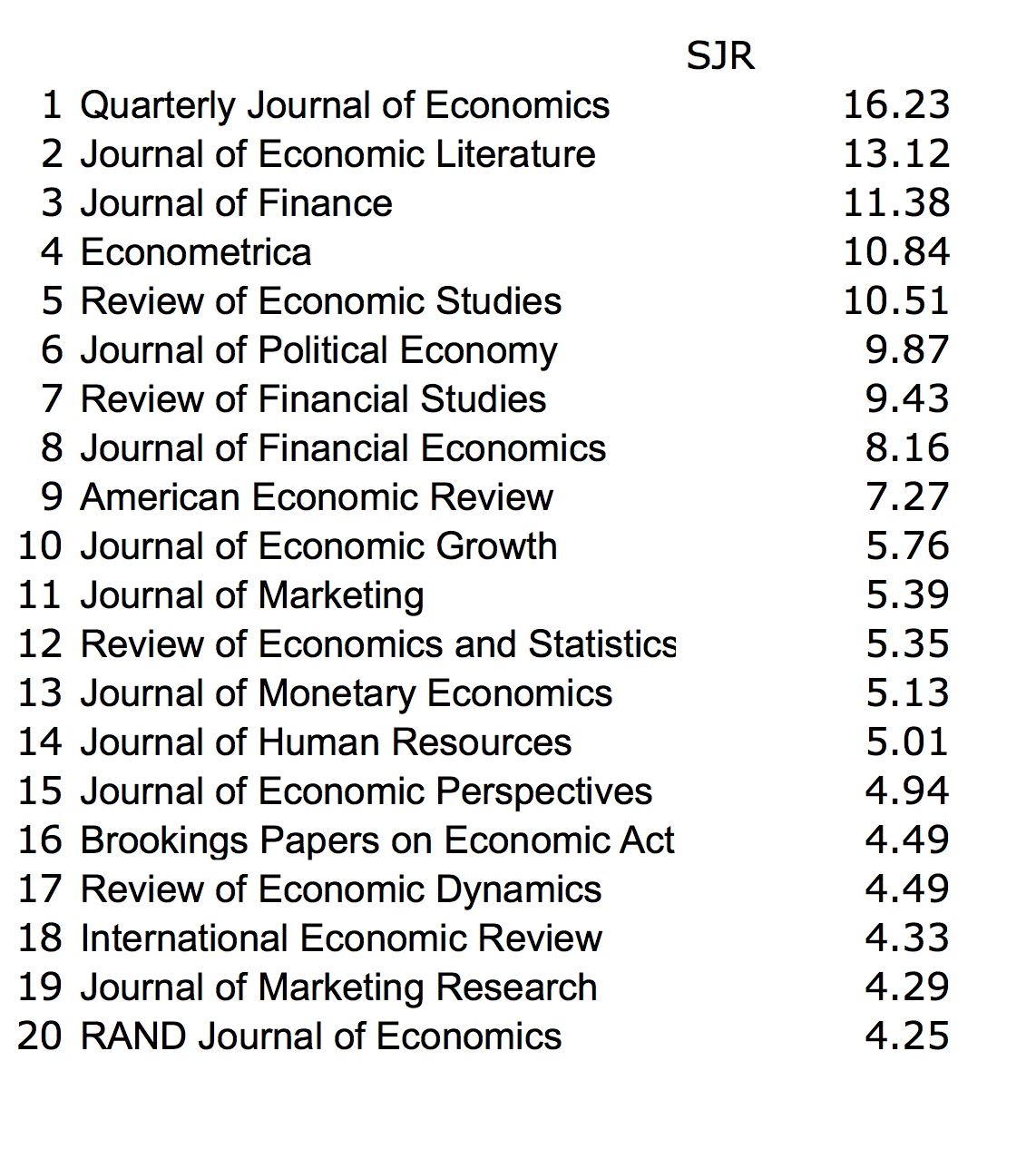
It looks very similar to the data for the full sample. So, it doesn't seem that there is a big difference between using one indicator or the other. Looking at the top 20 journals in economics and finance according to SJR, we have:

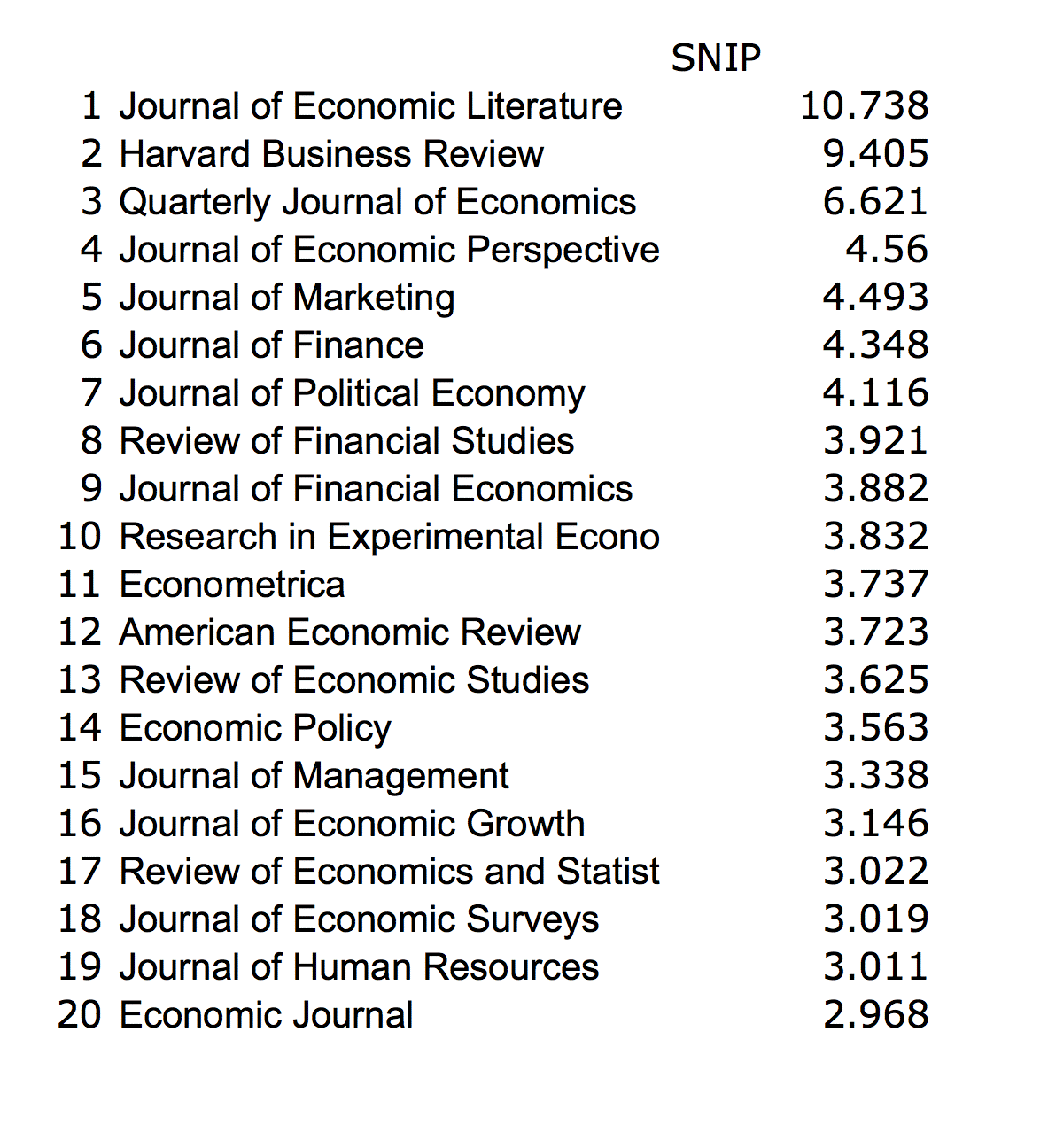
and looking at the top 20 according to SNIP we have:

The ranking by SJR does look a bit more intuitive I think. I'm thinking that long-term this is what we are going to be looking at using at the Crawford School once Elsevier have all the bugs out of the numbers :)

Monday, October 29, 2012

SNIP2

Elsevier has released it's latest journal impact factors - SNIP and SJR - and announcing some changes in the way they are calculated. They are now called SNIP2 and SJR2. SNIP stands for Source Normalized Impact per Paper and takes into account that citation practices vary across fields and the possibility to get cited is higher in some fields and lower than others. However, instead assigning each article to a field the adjustments are based on the length of reference lists in articles citing the journal in question and what share of those citations the journal in question has. SNIP2 makes some adjustments to reduce the effect of outliers and now the average SNIP will be 1 as will the average SJR. SJR is a recursive indicator similar to Article Influence or PageRank. Previously SJR strongly favored natural science journals and biomedical journals in particular. In other words, it wasn't source normalized. A first glance at the new numbers shows that SNIP doesn't look a lot different before, but that SJR numbers are now in similar ranges to SNIP.

At Crawford we are planning to allocate internal research funds awarded according to publication quantity and quality using SNIP to weight journal articles. It looks like the new metric will be just as suitable. We'll need more experience to see if SJR2 is superior to SNIP.

Monday, October 22, 2012

MYEFO Update

The Australian federal mid-year mini-budget was released this morning. The ARC pause on funding has been released and the Linkage program opened for applications. However, the SRE component "research quantum" will be cut relative to a projected inscrease as will so called facilitation funds. The research quantum are government funds for research provided to the universities partly based on their research performance that are similar to the overhead component in US grants. When you submit a grant application to the ARC here in Australia you do not include overheads in your proposal. This doesn't mean that the university doesn't earn overhead on successful grants. It's just done indirectly with a time lag. This is somewhat good news as the cuts are smaller than rumored and don't affect individuals applying for grants.

In total these cuts are estimated to cost ANU at least $3.4 million in 2013 and $8.1 million in 2014. 

More from The Australian here.


Saturday, October 20, 2012

ORCID is Now Open for Registration

I wrote about ORCID - a global system of free unique researcher IDs - more than a year ago. You can finally now register for ORCID and I just signed up and linked my data from my Scopus profile. Actually, it was Scopus' home page that alerted me to the possibility of getting an ORCID ID. Hopefully, this will really take off and allow the easy identification of researchers and their track records. Especially, those with common names like S. Liu or D. Stern.*

* D. I. Stern is a unique academic name but not all my publications or citations have both initials and David and Daniel Stern are very common names. This non-academic David I. Stern is pretty prominent too and I did find one David Ian Stern in Texas.

Friday, October 19, 2012

Journal Page Numbers are Disappearing

The UK-based Royal Society is dropping page numbers from its journal articles as it goes to the continuous publication model. This includes some of the oldest academic journals in existence.

I expect this trend to spread across academic publishing. The current situation with articles languishing in "online first" or "Articles in press" sections of journals for months or years (as in the example of my recent paper in Journal of Economic Surveys) before being included in a formal journal issue and being given a full citation is silly. I've read that journals do this to try to game citation impact factors, but I'm skeptical of that. It seems just to be conservatism to stick to the print production model when most access is now online.

Of course, some journals like Journal of Geophysical Research have been publishing articles with just article identifiers for more than a decade now and others like PLoS ONE started as pure online journals without page numbers.

Thursday, October 18, 2012

ARC Funding Freeze

There has been a lot of uncertainty recently about what is happening with research funding in Australia. There have been no announcements on when the next application rounds will open and around now the results of the ARC Discovery grant applications from earlier this year for funding next year should have been announced. The federal government has promised to deliver a budget surplus and was rumoured to be looking at cutting anything they could to achieve the goal. We got some information yesterday at a Senate hearing, where the ARC CEO - former ANU Dean of Science Aiden Byrne - and the minister both were questioned. We were told that there has been a funding freeze in place since August. It looks like that we might have more certainty after MYEFO or "minibudget", which will be released on Monday. But it also looks like that not as much funding will be available in the near future as there has been in the recent past.


Friday, October 12, 2012

Per Capita Energy Use in the UK

The history of energy use per capita is quite different in the UK compared to other developed countries. Already by 1800 about 3/4 of UK energy use was coal as the UK was the first country to industrialize. Energy use per capita peaks before the First World War and never really "recovers". In most other countries there was a very strong growth of energy use between the end of the Second World War and the oil price shocks in the 1970s.

This data is a rough estimate of "final energy use". The energy in electricity consumed is included in the data and the energy used to produce the electricity is deducted. Currently, electricity generation is about 40% efficient in the UK, meaning that 60% of the energy used to generate electricity is lost as waste heat. There are also about 7% losses of electricity in the transmission and distribution system.

Thursday, October 11, 2012

Energy Cost Share for England and Wales

Astrid Kander is visiting me to work on our ARC project. One paper we are working on is a comparison of Sweden and the United Kingdom. One of the our stylized facts on the relationship between energy and growth is that the share of energy in total production cost declines over time. This is very clear in the data from Sweden. But up till now, we've had very limited evidence for other countries. So we are putting together a comparable data set for England and Wales. The results are quite similar though less dramatic:
There are quite a lot of "kinks" in this data to be ironed out still, so this is very preliminary. We plan to fit the same model as we fitted to the Swedish data in our Energy Journal paper to this data too and then compare the results.

Tuesday, October 2, 2012

2012 US EIA Annual Energy Review

The EIA's Annual Energy Review was published a few days ago. This is a fantastic "one stop shop" overview of US energy data. The graphics are particularly good. However, like last year's report it is only US data. From last year, the AER dropped coverage of international data, though the EIA website still provides access to it.

Monday, October 1, 2012

Job Opportunity with the ICRC

Jack Gregory, who did a master research essay with me, which we now turned into this working paper, asked me to help find someone for this position:

We are currently looking for a recent grad to join the team at the Independent Competition and Regulatory Commission (the Commission):

The Commission is a statutory body set up to regulate prices, access to infrastructure services and other matters in relation to regulated industries (incl. water and electricity). Essentially, we are the economic regulator for the ACT.

Regarding the position, the key skills we are looking for are:

  • A background in economics, the environment or public policy;
  • A person with strong research and writing skills, capable of contributing discrete components to larger reports;
  • A person with above average skills in MS Excel and Word; and,
  • A person willing to learn on the job as well as possessing strong self-initiative and teamwork skills.

The position and salary will be commensurate with the successful applicant’s skills.  It will be at an ASO level, which is equivalent to the APS levels in the federal public service. Initially, we are looking for someone on a three to six month contract with the possibility of an extension.

Please visit www.icrc.act.gov.au for more information about the Commission or contact Jack on:

Phone - (02) 6205 8773

Email - jack.gregory@act.gov.au

Wednesday, September 26, 2012

Seminar at Crawford School: Astrid Kander - A Better Way to Assign Responsibility for Carbon Emissions

Astrid Kander will be visiting ANU for a couple of weeks next month and giving a seminar on the 22nd October. We are collaborating on my ARC project on energy transitions. Full details are at this link.

Abstract: 
This presentation will highlight one drawback of the currently very popular consumption based emission estimates for assessing the impact of international trade on carbon dioxide emissions in individual countries. The MRIO (multi regional input-output) method and the SRIO (single regional input-output) method with actual technologies are similar in that they aim at allocating all global CO2 emissions to the country of consumption of the commodities rather than to the producer country. However, both methods have one severe drawback when they are used for assessing responsibility for global emissions; i.e., they neglect the NEGA-emissions, which are the saved emissions in developing countries due to importing goods produced using cleaner technologies in developed countries.

If the amount of CO2 emissions of a country’s consumption, adjusted for international trade, is the key question, then the appropriate method should be the MRIO method (or the SRIO with actual technologies), adjusted for the NEGA-emissions possibly incurred. It is suggested that this revised method could also result in all countries’ emissions summing up to actual global emissions. This new way of measuring responsibility would increase the legitimacy of the calculations as a measure of responsibility for emissions because both the consumption levels and patterns and the production technologies and energy systems of all nations would be taken into account.

Tuesday, September 25, 2012

Post-Doc Position at Crawford School

I am looking for a post-doc to work with me on our ARC funded project Energy Transitions: Past, Present, and Future. As the ad says, we are looking for someone with expertise in computable general equilibrium and macro-economic modelling and an interest in energy and environmental economics and climate policy. If you are interested in the position, it's important to understand that you will be bringing expertise to our team that we don't have. So we really need someone who knows what they are doing rather than someone looking to use a post-doc to learn more about CGE modelling. That said, we do have faculty and students here at Crawford with expertise in CGE modelling and we have a strong concentration in environmental and resource economics and so this could be a good environment to develop your career in the field. I will certainly encourage the successful candidate to publish (including on previous research), attend conferences (some funding available) etc.

It will be an advantage if you have previously worked with the G-Cubed model but we will also consider candidates with experience with other models.

The higher stated salary is the rate of pay for a candidate with a completed PhD.

Please contact me if you have any questions about the position.

Monday, September 17, 2012

MAER-Net Colloqium

Somehow I never mentioned that I will be participating in this year's MAER-Net Colloqium in Perth. MAER-Net is a network of researchers using meta-analysis in economics. Meta-analysis is of course the statistical analysis of existing quantitative studies. It started in the area of medical and drug trials and is now used in many fields. There have been annual MAER Net Colloqia so far in Conway, Arkansas (home of Hendrix College and Tom Stanley), Cambridge, and now Perth. I'm presenting on our meta-analysis of the energy-GDP causality literature. We have a rough draft of a paper completed (as of yesterday) but I'd prefer to get some feedback at the workshop first before putting it up as an official working paper. We do have some interesting findings regarding this literature as well as some suggestions for new meta-analysis models. But if you are interested you will have to be patient :)

Also, a reminder that I will be giving a presentation at UWA on Friday.

Sunday, September 16, 2012

How Bad is the Academic Job Market?

History is supposedly one of the worst most over-supplied fields for academic employment. I often read about how "there are no jobs" and only going to Harvard or Princeton for your PhD can get you a job. But that is anecdote. Here are some data for the US history market. The main issue I think is that only 50% of starting PhD students ever complete the degree. However, of those that do complete the degree 60% end up with tenure track jobs within 10 years of starting. 20% end up in non-academic jobs and 20% are stuck with adjunct type positions that usually pay terribly and are very insecure. This doesn't seem that bad. Of course, the fraction who end up with jobs at research oriented universities is going to be quite small. If you want to have a good chance at a job like that you really do need to go to a top program. The same is true for other academic jobs markets like economics too, of course. Even though the economics job market is better but mainly because a lot of foreign students return to their home country and there are more good non-academic jobs available for econ PhDs.

Monday, September 10, 2012

$10,000 Top Up Awards for APAs

The College of Asia and the Pacific will pay top up awards of $10,000 per year to the most outstanding, newly commencing, PhD students who received APA awards (Australian government fellowships for domestic PhD students). This is a great opportunity to study for a PhD at the Crawford School and receive a much better than average stipend.

Friday, September 7, 2012

Fuel Choices in Rural Maharashtra

I have a new working paper up coauthored with former masters student Jack Gregory. The paper analyses data from two tribal area villages in Maharashtra State. Jack organized and supervised the survey when he worked for the NGO WOTR in India a few years ago. The surveyed was intended to provide data on greenhouse gas emissions and so had some shortcomings as an information source for understanding energy demand and the choice of fuel. Still, we thought it was worthwhile presenting this information to a wider audience.

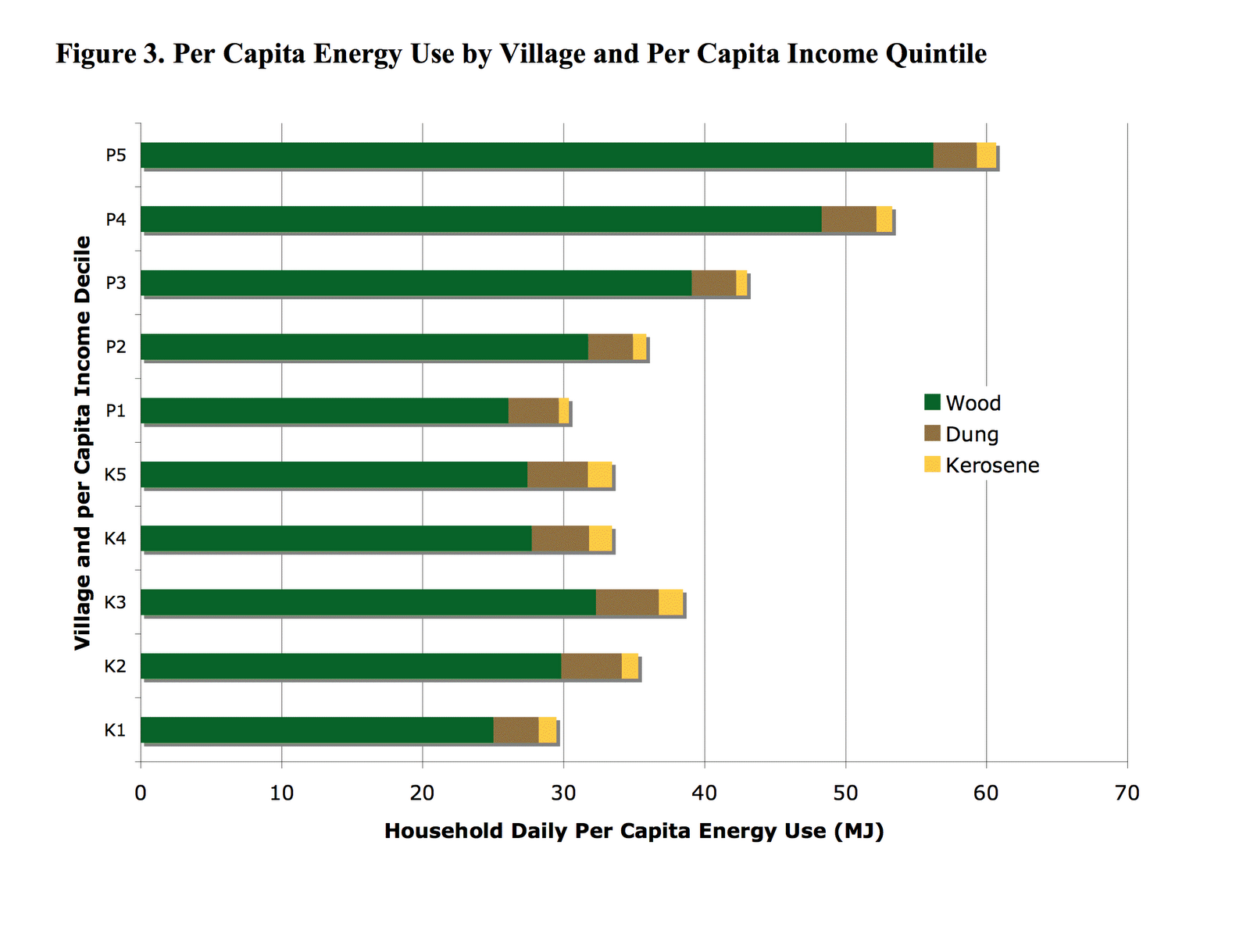
We found that there were really big differences between the villages. In the village of Purushwadi income had a big effect on energy use, but there was little relationship in the nearby village of Kohane. Unfortunately, we don't have any explanation for this difference. In Purushwadi the relationship between energy use and income was also different than that found in national surveys.

The national surveys show fairly constant use of biomass across income groups and increased use of modern fuels in the upper half of the income distribution in rural India (Khandker et al., 2012):


The numbers refer to income deciles. Unfortunately, we don't have data on electricity use, though we do have data on electricity connections. Here is the data for per capita energy use that we do have by income quintile in each village (P = Purushwadi, K = Kohane):


It seems to me that research in this area is mostly about coming up with common patterns but understanding more about the differences between villages might be also of interest.

Besides this, our modelling shows modest support for the energy ladder or rather "energy stacking" hypothesis. Energy stacking implies that rural households continue to use traditional fuels but add more and more of the modern ones as their income rises. Also we find that using higher quality energy sources reduces energy use, ceteris paribus. We also find that household size, stove ownership, and season influence rural energy choices. However, the effects of improved stoves are small and not consistent across the villages. This fits with recent evidence for modest or even perverse impacts of improved stoves.

Here are some pictures to give you an idea of what is involved in measuring energy use in rural India:

(a) Measuring rice with a 5 kg basket scale; (b) Measuring a headload of branches with a 25 kg hanging scale; (c) Measuring kerosene with a 200 ml graduated cylinder

Tuesday, September 4, 2012

Visitors to Crawford

We are very happy to welcome Professor Robert Costanza and Dr Ida Kubiszewski as Visiting Fellows to the Crawford School.


Professor Robert Costanza was Distinguished University Professor of Sustainability, in the Institute for Sustainable Solutions at Portland State University. Before moving to PSU in late 2010, he was the Gund Professor of Ecological Economics and founding director of the Gund Institute for Ecological Economics at the University of Vermont. Before Vermont, he was on the faculty at Maryland and LSU, a visiting scientist at the Beijer Institute in Sweden, and at the Illinois Natural History Survey. Bob is also currently a Senior Fellow at the National Council on Science and the Environment, Washington, DC, and a Senior Fellow at the Stockholm Resilience Center, Stockholm, Sweden, and an Affiliate Fellow at the Gund Institute for Ecological Economics at the University of Vermont. Bob is co-founder and past-president of the International Society for Ecological Economics, and was chief editor of the society's journal, Ecological Economics from its inception in 1989 until 2002. He is founding co-editor (with Karin Limburg and Ida Kubiszewski) of Reviews in Ecological Economics. He currently serves on the editorial board of ten other international academic journals. He is also founding editor in chief of Solutions (www.thesolutionsjournal.org ) a unique hybrid academic/popular journal. Bob is the author or co-author of over 500 scientific papers and 23 books. His work has been cited in more than 11,000 scientific articles and he has been named as one of ISI’s Highly Cited Researchers since 2004.


Dr Ida Kubiszewski was a Research Assistant Professor and Fellow at the Institute for Sustainable Solutions, at Portland State University. She is also the Managing Editor of a magazine/journal hybrid called Solutions, launched January 2010. Solutions is an outlet for discussions focusing on solutions to the complex problems we are now facing in the context of whole systems design for a sustainable and desirable future. She is also the co-editor (with Karin Limburg and Robert Costanza) of Reviews in Ecological Economics, published annually by Springer, providing in-depth reviews of the most timely and important issues in the field of Ecological Economics. Ida is also a co-founder and former-Managing Editor of the Encyclopedia of Earth, an electronic reference about the Earth, its natural environments, and their interaction with society. She is a Junior Fellow at the National Council for Science and the Environment and sits on the steering committees or advisory boards of various organizations including the Ecosystem Service Partnership, Environmental Information Coalition, and the U.S. Society for Ecological Economics.

Article on Climate Mitigation Costs in The Conversation


I have an article today in The Conversation explaining the main findings of our recent paper in AJARE. This time I managed to squeeze the "low hanging fruit" in. There is even a picture of bananas :) Go over to The Conversation to read and discuss it.

Crawford School Moves Up to Number 4 (or 2) in Australia


Following the move of CAMA from the College of Business and Economics to the Crawford School, Crawford has jumped from #6 in the RePEc ranking for Australia to #4. Crawford actually is the second highest ranking Australian department in the World ranking in economics after Monash. This is because Australian universities are strong in different indicators than typical institutions globally are.

The Crawford School first entered the top 20% list for Australia in May 2007 at 18th.